Best Adjustable Beds for Seniors (2026): What Actually Helps vs. What's Marketing
An adjustable bed base can ease acid reflux, swelling, and the simple mechanics of getting up at night — but the feature that sells it in a showroom (massage, USB ports, app control) usually isn't the feature that matters for an older sleeper. Here's what to actually check before buying one, and which models hold up.
As an Amazon Associate I earn from qualifying purchases. We independently review products; buying through our links never costs you extra.
Best Overall
Zinus Deluxe Smart.Bed Adjustable Bed Base
Quick picks
| Product | Best for | Amazon |
|---|---|---|
| Zinus Deluxe Smart.Bed Adjustable Bed Base | Overall | Check price on Amazon |
| LUCID L150 Adjustable Bed Base | No-Frills Option | Check price on Amazon |
| Zinus Smart Adjust Adjustable Bed Frame with Wall Hugging Technology | Nightstand Access | Check price on Amazon |

Our Top Picks
Chosen for seniors based on features, specs, and verified buyer reviews.
Zinus Deluxe Smart.Bed Adjustable Bed Base
- Built-in USB charging ports at the base
- LED under-bed lighting for nighttime trips
- Wireless remote with physical buttons
- Available in sizes that combine to king
- Massage feature is extra battery/motor complexity some buyers won't use
- Heavier to move than a basic flat foundation
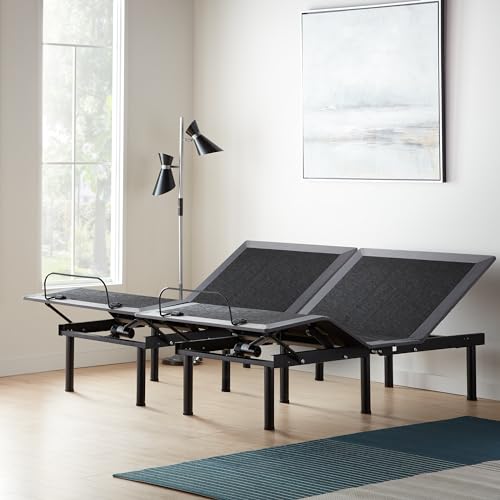
LUCID L150 Adjustable Bed Base
- Quiet motor for head-and-foot incline
- Lower price than lighting/massage models
- Simple wireless remote
- Straightforward two-person assembly
- No under-bed lighting
- No wall-hugging hinge design
Zinus Smart Adjust Adjustable Bed Frame with Wall Hugging Technology
- Wall-hugging hinge keeps sleeper near the headboard
- Adjustable leg height for easier standing
- Wireless remote with head/foot incline presets
- Whisper-quiet motor per manufacturer spec
- Costs more than the base Zinus Smart Adjust model without the hinge feature
- Twin XL and Queen only in some listings — check size availability
An adjustable bed base changes the angle of the mattress instead of the mattress itself, and for a lot of age-related sleep complaints, that's the more useful fix. Raising the head end reduces the nighttime reflux and post-nasal drip that flat sleeping makes worse. Raising the legs takes pressure off swollen ankles and lower-back strain. And a base that lifts the whole upper body most of the way to sitting turns "get up out of bed" from a full sit-up into a much smaller movement — which matters more than most buyers expect until they're the one doing it at 2 a.m. Our top pick is the Zinus Deluxe Smart.Bed Adjustable Base for its combination of quiet motor, USB ports, and under-bed LED lighting; the LUCID L150 Adjustable Bed Base is the better call for a household that wants head-and-foot incline without paying for massage or lighting extras it won't use.
What actually matters for an older sleeper
Motor noise, not motor speed
Every adjustable base moves at roughly the same speed — the spec that actually varies, and matters, is how loud it is doing it. A base that whines or clunks on every adjustment is annoying at 7 p.m. and genuinely disruptive at 2 a.m. when a spouse is trying to sleep through it. Reviews that specifically mention "quiet" or "whisper-quiet" motors are worth weighting more than horsepower or incline-angle specs, which barely differ between models.
Wall-hugging or "wall glide" hinge design
A standard adjustable base pivots from a fixed point, which walks the sleeper's head away from the headboard and toward the foot of the bed as it inclines — meaning a nightstand lamp or phone charger ends up out of reach right when it's needed most. A wall-hugging hinge design keeps the sleeper roughly in the same spot relative to the headboard through the full range of motion. It's a genuinely useful feature for this age group, not a marketing add-on.
Adjustable leg height
Standard bed frames sit at a fixed height that's often too low for someone with knee or hip arthritis to rise from comfortably. Bases with independently adjustable leg height let the whole bed sit a couple of inches taller, which measurably reduces how much knee bend is needed to stand up — a small change that a lot of buyers don't think to check for until they're already living with a base that's too low.
Under-bed lighting
A soft light strip along the base's underside, triggered by a remote button or a foot-sensing motion sensor, is one of the few "smart" features on these beds that solves a real problem: a 2 a.m. bathroom trip is when falls happen, and finding a light switch in the dark is exactly the moment a senior doesn't want to be fumbling.
A remote with real buttons
App-controlled bases look modern in a showroom, but for a lot of older users a phone app buried behind a login and a Bluetooth pairing step is friction they don't want at bedtime. A simple wired or wireless remote with large, clearly labeled physical buttons — head up, head down, foot up, foot down, flat — is the more usable design for daily use, even if it looks less impressive on a spec sheet.
Our picks
Zinus Deluxe Smart.Bed Adjustable Base — Best Overall
Built-in USB ports at the base level mean a phone or tablet can charge within reach without an extra cord running across the nightstand, and the LED under-bed lighting is genuinely useful rather than decorative. It includes a foot-of-bed massage setting some buyers won't use but that adds real comfort for restless-leg or circulation complaints. The wireless remote uses physical buttons, and the queen and Twin XL sizes both ship at a lower price point than premium mattress-brand bases.
LUCID L150 Adjustable Bed Base — Best No-Frills Option
Head-and-foot incline, a wireless remote, and a motor reviewers consistently describe as quiet, without the massage or lighting extras that push up the price on fancier models. For a buyer who wants the core medical benefit — raising the head or legs — without paying for features that go unused, this is the more sensible spend.
Check price on AmazonLUCID L150 Adjustable Bed Base
Zinus Smart Adjust Adjustable Bed Frame with Wall Hugging Technology — Best for Nightstand Access
The wall-hugging hinge keeps the sleeper close to the headboard through the full incline range, which matters if the nightstand holds a lamp, a phone charger, or a water glass that needs to stay within arm's reach while sitting up in bed. Adjustable leg height is included, useful for raising the whole bed to an easier standing height.
What an adjustable base won't fix
It's worth being direct about the limits here. An adjustable base changes sleeping angle — it does not replace CPAP therapy for diagnosed sleep apnea, and elevating the head is a comfort measure for mild reflux, not a substitute for a doctor's guidance on more serious gastroesophageal reflux disease. It also doesn't fix a mattress that's already worn out or sagging; putting an old, broken-down mattress on a new adjustable base just means a new base is now bending an old, unsupportive mattress into different shapes. If the mattress is more than seven or eight years old, budget for replacing both together — a new base under an old mattress is a common way this purchase disappoints people.
Fit and installation realities
Adjustable bases require a compatible mattress — most memory foam and modern hybrid mattresses flex with an adjustable base fine, but a rigid innerspring mattress built for a flat frame can be damaged by repeated bending, and some mattress warranties are voided by using one on an adjustable base without checking first. Queen-size adjustable bases are typically one solid unit, while king-size setups are usually two Twin XL bases pushed together and controlled by a single remote — which means a slight gap or independent movement between the two sides is normal, not a defect, and it's worth knowing that going in rather than being surprised by it. Footboards and existing bed frames usually need to come off entirely; an adjustable base isn't designed to slide inside a decorative frame the way a flat foundation does, so factor in losing that piece of furniture, at least temporarily, when planning the swap.
When a $30 wedge pillow is actually the smarter buy
Not every case calls for a $400–$800 adjustable base. Someone who wants a modest head elevation for occasional post-nasal drip or mild reflux, and who isn't dealing with mobility limitations getting in and out of bed, often gets the same practical benefit from a foam wedge pillow at a fraction of the cost and with zero installation — see our guide to pillows for neck and shoulder pain for options built specifically for incline and positioning, not just a flat cushion. An adjustable base earns its price when the need is ongoing and combines more than one problem — reflux plus difficulty standing from a flat bed, or swelling plus a caregiver who needs the head raised for feeding or medication administration. Sizing the purchase to the actual problem, rather than buying the full-feature model because it's available, is the more useful advice than any single spec on the box.
Trial periods and return policies matter more than usual here
Adjustable bases are bulky, heavy, and awkward to return once assembled and placed under a mattress — which makes the seller's return window worth checking before ordering, not after a problem shows up. A base that turns out to be too loud, sits at the wrong height even after leg adjustment, or simply doesn't suit how someone sleeps is a much bigger hassle to send back than a smaller purchase would be. Buying from a retailer with a genuine return policy for large furniture items, and confirming who pays return shipping on an item this size, is worth the extra five minutes before checkout. It's also worth asking whether the retailer will pick up the old box spring or frame being replaced, since disposal is its own logistical problem for anyone who can't easily haul a bed frame to the curb.
Frequently asked questions
Will an adjustable bed base work with my current mattress?
Most memory foam and hybrid mattresses flex safely with an adjustable base. Older innerspring mattresses built for a rigid flat frame are the main exception — check the mattress manufacturer's warranty terms before assuming it's compatible, since some warranties explicitly exclude adjustable-base use.
Is the massage feature on these beds worth paying extra for?
For general comfort, it's a nice-to-have rather than a need-to-have, and it's usually one of the first features cut on budget models. If restless legs or circulation issues are a specific, ongoing complaint, it can genuinely help; otherwise the money is better spent on a quieter motor or a wall-hugging hinge, which affect daily use more directly.
Can an adjustable bed base help with sleep apnea?
Raising the head end can reduce mild snoring and some positional apnea symptoms for certain people, but it is not a treatment for diagnosed obstructive sleep apnea and shouldn't replace a CPAP machine or a doctor's treatment plan. Mention it to a sleep physician rather than treating the bed as a substitute for prescribed therapy.
Do I need a professional to set one up?
Most adjustable bases are designed for two people to assemble without tools beyond what's included, generally in under an hour. The heavier lift, in both senses, is usually removing the old frame and footboard first, not assembling the new base itself.
How loud are these when they're actually running?
Quality varies more than most buyers expect — some motors are genuinely close to silent, while cheaper units have an audible whir or occasional clunk at the top or bottom of the range of motion. Checking verified buyer reviews specifically for noise complaints is more reliable than the word "quiet" in a product description, which every listing uses regardless of how the motor actually sounds.


