Best Bed Exit Alarms & Bed Sensor Pads for Fall Prevention (2026)
A bed exit alarm alerts a caregiver the moment someone gets up unassisted — the exact moment most nighttime falls happen. It's a different tool than bed rails or an adjustable bed base, built specifically for that one high-risk transition.
As an Amazon Associate I earn from qualifying purchases. We independently review products; buying through our links never costs you extra.
Best Overall
Smart Caregiver Bed Exit Alarm with Wireless Pager
Quick picks
| Product | Best for | Amazon |
|---|---|---|
| Smart Caregiver Bed Exit Alarm with Wireless Pager | Overall | Check price on Amazon |
| Upgraded Bed Sensor Alarm and Fall Prevention System | Long Range | Check price on Amazon |
| Lunderg Bed & Chair Alarm Set | Pre-Alert Warning | Check price on Amazon |

Our Top Picks
Chosen for seniors based on features, specs, and verified buyer reviews.
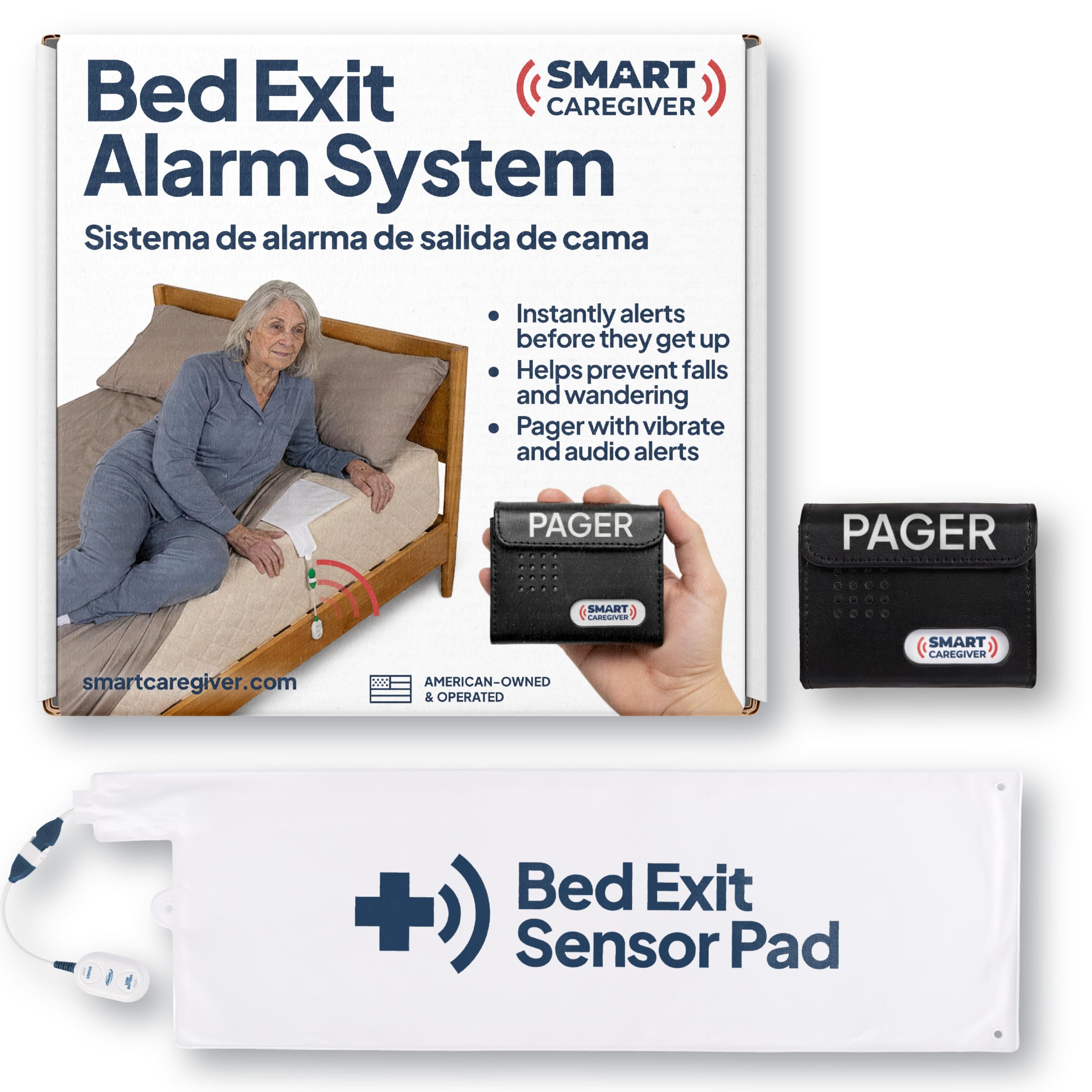
Smart Caregiver Bed Exit Alarm with Wireless Pager
- 10" x 30" weight-sensing pad is large enough to stay under most people reliably
- Wireless pager frees the caregiver from staying within earshot of the room
- Widely used in home-care settings with a long track record
- Standard range (around 300 feet) may not cover a larger home
- Pad needs periodic repositioning checks to stay accurate

Upgraded Bed Sensor Alarm and Fall Prevention System
- Long-range alert signal, well beyond a typical single-floor home
- Focuses specifically on the get-up moment rather than general bed movement
- Good fit for a larger house or a caregiver sleeping on a different floor
- Larger range comes with a higher price than basic pad-and-pager kits
- More settings to configure during initial setup

Lunderg Bed & Chair Alarm Set
- Pre-alert technology flags early movement before a full exit, giving a caregiver more response time
- Includes a matching chair pad for daytime use in a recliner or wheelchair
- Adjustable sensitivity to reduce false alarms from normal repositioning
- Earlier alerts can mean more frequent notifications if sensitivity isn't tuned
- Two-pad set costs more than a bed-only kit
The Specific Moment This Solves
Most nighttime falls don't happen while someone is lying in bed — they happen in the seconds after standing up, when balance hasn't caught up yet, in a dark room, often on a trip to the bathroom. A bed exit alarm uses a weight-sensing pad placed under the sheet or mattress to detect when that weight lifts off, and immediately alerts a caregiver — through a bedside pager, a phone app, or both — so someone can respond before the person is unsteady and alone. It doesn't prevent the fall by itself; it gets help there faster, and for some systems, the early-warning models give a caregiver time to reach the room before the person is even fully upright.
Our Top Picks
These cover the range from a straightforward pad-and-pager setup to systems with longer range and earlier-warning technology.
Pad-Based vs. Motion-Sensor Alarms
Weight-sensing bed pads (what these four use) are generally more reliable than motion-sensor versions that watch the room, because they trigger on an actual attempt to leave the bed rather than any movement in the room, which cuts down on false alarms from rolling over or a pet jumping up. The tradeoff is that a pad needs to be positioned correctly under the person, not just anywhere on the mattress, and can shift out of place over time — check its position periodically rather than assuming it's still where it was installed.
Pair With, Not Instead Of
A bed exit alarm buys response time; it doesn't replace the physical safety setup around it. If getting up is unsteady, a bed assist rail gives something to push up from at the exact moment the alarm is triggering, and a clear, lit path to the bathroom matters just as much as the alert itself. Our bathroom safety guide covers the other end of that same nighttime trip.
Who This Is — and Isn't — For
Bed exit alarms are built for households where someone else is present to respond: a spouse in the next room, a caregiver on a night shift, or an adult child staying over. For someone who lives entirely alone with no one to alert, a bed exit alarm doesn't add much — a wearable medical alert with fall detection is the better fit there, since it works throughout the day too, not just at the bedside. Our medical alert systems guide covers that broader, all-day option.
What to Look For in a Bed Exit Alarm
Once you've decided a bed alarm fits the household, a few practical features separate a system that gets used from one that ends up unplugged in a drawer. None of these are exotic — they're the details that decide whether the alarm is reliable at 3 a.m. when it actually matters.
- Pad size and placement. A wider, longer sensing pad is more forgiving of someone who sleeps toward one edge of the bed. A pad that's too small only reads weight from the center of the mattress, so a person who habitually gets up from the side can lift off the sensor without triggering it. Match the pad to how the person actually lies in bed, not to the middle of the mattress.
- Alert range and where the caregiver sleeps. The whole system depends on the caregiver hearing the alert. Measure the real distance — and the walls and floors in between — from the bed to wherever the responder sleeps, and choose a range comfortably beyond that. A signal rated for a single room is fine for a spouse in the next bed but not for an adult child sleeping upstairs.
- Pager, phone app, or both. A self-contained pager keeps working when the internet or Wi-Fi goes down, which matters for a device whose whole job is nighttime reliability. App notifications add reach — useful for a caregiver who moves around the house — but shouldn't be the only alert path. The most dependable setups keep a local pager as the primary alert and treat phone notifications as a bonus.
- Adjustable sensitivity and pre-alert timing. Being able to tune how early the alarm fires lets you match it to the person. Someone who's slow and deliberate getting up gives you more warning; someone who's up and moving fast needs the earliest possible alert. If the alarm fires too often for normal shifting, sensitivity that's too high is usually the cause.
- Cordless vs. corded pads. A pad connected to the pager by a cord is one more thing to trip over near the bed and one more thing that can pull loose. Fully wireless pad-to-pager systems remove that hazard, though they add batteries to keep an eye on.
- Low-battery and fault warnings. A bed alarm that quietly dies is worse than no alarm, because it creates false confidence. Look for a system that clearly signals a low battery or a disconnected pad rather than simply going silent.
How to Choose the Right One for Your Situation
If a caregiver sleeps in the same room, a basic pad-and-pager system with standard range is usually all you need — the priority is a reliable pad and a simple alert, not long range. If the responder sleeps on another floor or across a larger home, prioritize a long-range model, and test the alert from the actual sleeping spot before relying on it.
If the person tends to get up quickly or impulsively — common with some forms of cognitive change — a pre-alert model that flags early movement buys the extra seconds you need to reach the room before they're upright and walking. If the concern is dementia specifically, pair the bed alarm with a plan for the rest of the night: a person who gets up disoriented needs a lit, clear path and ideally a dedicated door alarm for dementia wandering too, since the bed alarm only covers the first moment of the trip. If the household budget is tight, a single bed pad and pager covers the highest-risk transition; you can add a matching chair pad later if daytime standing becomes a concern.
Common Mistakes to Avoid
- Buying range you don't need — or less than you do. The single most common regret is a caregiver on a different floor who can't hear a room-range pager. Buy for the real layout of the home.
- Setting sensitivity so high it cries wolf. An alarm that goes off every time the person rolls over gets muted or unplugged within a week, which defeats the entire purpose. Tune it so it fires on a genuine exit attempt, not on normal movement.
- Placing the pad once and forgetting it. Pads drift out of position under a fitted sheet over days and weeks. A pad that's slid toward the footboard may no longer read the person's weight. Build a quick weekly position-check into the routine.
- Treating the alarm as the whole safety plan. The alarm tells you the person is getting up; it does nothing to make the getting-up or the walk safer. That's a job for a bed rail, lighting, and a clear floor.
- Skipping a battery-check habit. A wireless pad and pager both run on batteries. Pick a predictable day to check them so the system is never silently dead.
Setting It Up
Setup is genuinely simple, but a few minutes of care up front pays off. Place the pad under the fitted sheet, centered on where the person's hips and torso rest when lying down — not in the middle of the mattress if they sleep off to one side. Smooth the sheet so the pad lies flat and doesn't bunch. Put the pager wherever the caregiver will actually be, and then test it for real: have the person lie down, then get up as they normally would, and confirm the alert fires and is clearly audible from the caregiver's spot. Adjust sensitivity if it either misses the exit or triggers on shifting. If the mattress has a thick memory-foam topper, test again with it in place — deep toppers can soften the weight signal and may need a slightly higher sensitivity setting. Re-run this quick test after any change to the bed or bedding.
Fall Prevention Beyond the Alarm
An alarm shortens the response time; the rest of the bedroom decides whether the person stays on their feet in the first place. A few low-cost changes matter as much as the device itself:
- Light the path. A motion-activated night light between the bed and the bathroom removes the single biggest nighttime hazard — walking an unlit route with half-awake balance. Warm, low-glare lighting is easier on eyes adjusting from sleep.
- Clear the floor. Remove throw rugs, cords, and clutter along the nighttime route. A loose rug edge is a classic trip point, and it's free to fix.
- Give them something to push up from. A sturdy bed assist rail or a stable nightstand at the right height turns an unsteady stand into a supported one, right at the moment the alarm is sounding.
- Keep essentials within reach. Water, glasses, a phone, and a lamp switch at the bedside reduce how often the person needs to get up in the dark at all.
- Consider bed height. A bed that's too high or too low makes standing harder. Feet flat on the floor with knees at roughly a right angle is the easiest, safest height to rise from.
Frequently Asked Questions
Will the pad wake the person up when they shift position in bed?
No — a properly positioned weight-sensing pad detects the person's weight leaving it entirely, not shifting or rolling over on top of it, so normal movement in bed shouldn't trigger a false alarm once it's correctly placed.
How far does the pager need to be to work?
Range varies by model — some cover a few hundred feet, enough for a caregiver in another room of the same home, while others are rated for much longer range, better suited to a larger house or when the caregiver sleeps on a different floor. Check the specific range against the home's layout before buying.
Can this work with a hospital bed or an adjustable bed base?
Yes — the pad sits under the sheet on top of whatever mattress or bed base is already in use, so it generally works the same way with a standard bed, a hospital bed, or an adjustable base, though very thick mattress toppers can sometimes reduce sensitivity and are worth testing after setup.
Does it require an internet or Wi-Fi connection?
Most pad-and-pager systems are self-contained and use their own wireless signal between the pad and a bedside pager rather than home Wi-Fi, so they'll work even if the internet goes down. Some newer app-connected versions do use Wi-Fi for phone notifications in addition to the pager — check which setup a specific model uses.
How is this different from a chair alarm?
Same underlying technology, different location — a chair alarm uses the same weight-sensing approach on a recliner or wheelchair cushion to catch unsupervised attempts to stand from a seated position during the day. Several bed alarm systems, including ones on this list, sell matching chair pads as an add-on for exactly that daytime use case.
How long do the batteries last, and what happens when they run low?
Battery life varies widely by model and how often the alarm triggers, so check the specific product rather than assuming. What matters more is choosing a system that clearly warns you before a battery dies rather than going silent — and building a simple weekly or monthly check into your routine so you're never caught out.
Can one pager cover both a bed pad and a chair pad?
Many systems are designed so a single pager receives alerts from more than one sensor, letting you add a chair pad for daytime use without a second receiver. Whether a specific model supports pairing multiple pads varies, so confirm it before buying if you want both bed and chair coverage on one alert.
Is a bed exit alarm considered a restraint?
No — a bed exit alarm doesn't restrict movement at all. It simply notifies a caregiver that the person is getting up, leaving them completely free to move. That's an important distinction from bed rails used to confine someone, which raise separate safety and dignity concerns. An alarm supports independence by letting the person move while making sure help is nearby.
Will the alarm disturb the person's sleep?
A properly set up system alerts the caregiver, not the sleeper — the pager or phone is on the caregiver's side, and the pad itself is silent. If the alert is audible in the bedroom and is waking the person, move the pager farther from the bed or route alerts to a phone the caregiver keeps with them.
What should the caregiver actually do when the alarm goes off?
The goal is to reach the person calmly before they're up and walking unassisted. Rushing in can itself startle someone who's disoriented. A steady, reassuring approach — offering a hand or steadying arm rather than pulling them up — tends to work best. It helps to agree on a simple plan in advance so the response is the same every time.
The Bottom Line
For a household where someone is present to respond, a bed exit alarm targets the single riskiest moment in a senior's night — getting up unassisted — and gets a caregiver there faster than waiting to hear a fall happen. Pair it with a bed rail and a clear, lit path to the bathroom, and treat it as one layer of a broader nighttime safety setup rather than a fix on its own.


