Best Call Blockers for Seniors (2026): Stopping Robocalls and Scam Calls Before They Ring
Phone scams targeting older adults are usually a numbers game — scammers dial thousands of landlines a day hoping a small percentage pick up. A dedicated call blocker stops the phone from ringing at all for known scam numbers, which does more to protect a parent or grandparent than any amount of warning them to "just hang up." Here's what actually works, and what to use instead if the calls are landing on a cell phone rather than a landline.
As an Amazon Associate I earn from qualifying purchases. We independently review products; buying through our links never costs you extra.
Best Starting Point
CPR V5000 Call Blocker
Quick picks
| Product | Best for | Amazon |
|---|---|---|
| CPR V5000 Call Blocker | Starting Point | Check price on Amazon |
| CPR V100K Call Blocker | Heavy Call Volume | Check price on Amazon |
| CPR V10000 Call Blocker | a Vulnerable Family Member | Check price on Amazon |
| SENTRY 2.0 Dual Mode Call Blocker | Alternative Worth Comparing | Check price on Amazon |

Our Top Picks
Chosen for seniors based on features, specs, and verified buyer reviews.
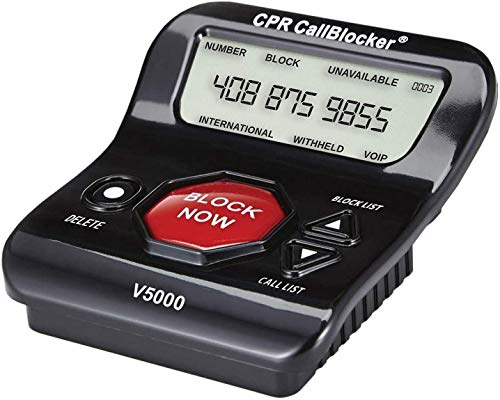
CPR V5000 Call Blocker
- Preloaded with 5,000 known scam and nuisance numbers
- One-button manual blocking for up to 1,500 more numbers
- No app, subscription, or extra power supply needed
- Requires Caller ID service on the phone line
- Smaller preloaded database than the V100K or V10000

CPR V100K Call Blocker
- 100,000 preloaded nuisance numbers
- 3-inch caller ID display shows who's calling before you answer
- Compatible with AT&T, Panasonic, Uniden, Motorola, VTech and most major landline phones
- Not compatible with VoIP/digital phone services like Vonage, Ooma, or Xfinity Voice
- Higher price than the V5000
CPR V10000 Call Blocker
- Over 10,000 preloaded scam numbers
- Custom Allow List mode only rings through approved numbers
- One-tap blocking, no monthly fees
- Allow-list mode can be too restrictive for households with lots of unfamiliar legitimate callers
- Mid-range price between the V5000 and V100K
SENTRY 2.0 Dual Mode Call Blocker
- Blocks robocalls, telemarketers, and political/survey calls
- Easier list management than the original Sentry model
- No subscription required
- Smaller scam-number database than the CPR lineup
- Less widely reviewed than the CPR devices
If scam and robocalls are hitting a landline, the fastest fix is a dedicated call-blocking device that sits between the phone line and the handset and silently intercepts known scam numbers before the phone ever rings. The CPR V5000 is the simplest option and the one we'd recommend first. The CPR V100K blocks far more numbers and adds a caller ID screen, worth the extra cost for someone getting hit constantly. If the calls are coming to a cell phone instead, none of the devices below will help — skip to the free carrier and app options near the end.
Why do scam calls target older adults so heavily?
Robocall operations dial enormous volumes of numbers automatically, and landlines skew older because younger households have largely dropped them. Scammers also specifically target landlines because caller ID spoofing is cheap and the FTC's Do Not Call Registry has no enforcement teeth against overseas operations, which make up a large share of the calls. The result is that a senior with a landline can receive a dozen or more scam calls a day, and repetition is part of the tactic — the more familiar and urgent a scam call sounds, the more likely someone is to eventually engage with one.
How does a call blocker actually work?
It intercepts the call before the phone rings
A physical call blocker plugs in between the wall jack and the phone (or between the base station and the jack, for cordless systems). It reads the incoming caller ID against a preloaded and constantly-growing list of known scam and robocall numbers, and if there's a match, it silently disconnects the call before the connected phone ever rings. Legitimate calls pass through untouched.
It doesn't require an app, a subscription, or tech support
This is the detail that makes these devices genuinely useful for this audience: there's no app to install, no account to manage, and no monthly fee on any of the models below. Setup is plugging in a cord and, on most models, pressing one button to manually block a number that slipped through — a physical, tactile interaction that doesn't require remembering a phone menu or a software update.
Our picks
CPR V5000 — Best Starting Point for Most Households
The V5000 comes preloaded with 5,000 known scam and nuisance numbers and lets you manually block up to 1,500 more with a single large "BLOCK NOW" button — press it while a call is ringing or right after hanging up, and that number is permanently silenced going forward. It needs no power supply beyond the phone line itself, no app, and no subscription. The one requirement: the phone line needs Caller ID service active through the phone company, which is a small added monthly cost if it isn't already on the account.
CPR V100K — Best for Heavy Call Volume
The V100K steps up to 100,000 preloaded nuisance numbers and adds a 3-inch caller ID display so a family member can see who's calling before picking up, not just after a block decision. It's compatible with analog landline phones from AT&T, Panasonic, Uniden, Motorola, VTech, and most other major landline phone brands. The important caveat: it is not compatible with internet-based or digital phone services — Vonage, Ooma, Xfinity Voice, Quantum Fiber, and similar VoIP providers won't work with this device, only a traditional analog copper landline. Check the type of phone service before buying this specific model.
Check price on AmazonCPR V100K Call Blocker
CPR V10000 — Middle Ground with a Custom Allow List
The V10000 sits between the two above on scale, with over 10,000 preloaded scam numbers, but its standout feature is a Custom Allow List mode — instead of blocking known bad numbers, it can be flipped to only ring through for numbers on an approved list, which is a meaningfully higher level of protection for someone who receives calls almost exclusively from a small, known set of family members and doctors' offices. It's a better fit for someone in the early stages of a scam-vulnerability concern (early cognitive decline, for instance) than the other two, which still let any unrecognized number ring through by default.
SENTRY 2.0 Dual Mode Call Blocker — Alternative Worth Comparing
The Sentry 2.0 takes a similar approach — it's designed to block robocalls, telemarketers, and even political and survey calls, and improved setup over the original Sentry model with easier number list management. It's a reasonable alternative to the CPR lineup if a specific household already has one on hand or finds its interface preferable, though CPR's larger preloaded scam-number databases generally make the V5000 or V10000 the stronger first buy for most people.
How do I choose between these four?
Start with the phone service type — analog landline versus VoIP — because that single fact eliminates options immediately; the V100K specifically will not work on a VoIP line. From there, match the device to how the calls are actually happening: occasional nuisance calls call for the V5000's simplicity, near-constant scam call volume calls for the V100K's larger database and caller ID screen, and a household worried about a vulnerable family member accidentally engaging with a scammer benefits most from the V10000's allow-list mode. None of these devices requires paying more for a feature that goes unused — the cheapest option, the V5000, handles the majority of household scam-call problems just fine.
What if the scam calls are coming to a cell phone instead?
None of the hardware above works on a mobile phone — there's no physical line to intercept. The good news is that cell carriers and free apps cover most of the same ground:
Verizon Call Filter comes free on Verizon lines and automatically routes likely spam to voicemail, with an optional paid tier (Call Filter Plus) for more detailed spam-risk information. AT&T Call Protect (built on Hiya's detection technology) does something similar for AT&T customers at no cost for the basic tier. Nomorobo works across T-Mobile, Verizon, and AT&T on both iPhone and Android, and is built specifically around the fact that scammers disproportionately target older callers. YouMail offers a free tier plus paid Plus ($5.99/month) and Professional ($14.99/month) tiers with more aggressive blocking and reputation monitoring. All four require installing an app or activating a carrier feature rather than plugging in a device — a bigger ask for someone uncomfortable with smartphone settings, which is exactly why a family member should do this setup in person rather than walking someone through it over the phone.
Common mistakes when setting one of these up
The most common mistake is buying a call blocker without checking whether the phone line is a true analog landline or a VoIP/digital service routed through the same jack — a growing number of "landline" services from cable and fiber providers are actually VoIP under the hood, and a device like the V100K simply won't function on them. The second mistake is skipping Caller ID service on the phone plan; without it, none of these devices can identify or block anything, since they work by reading caller ID data. The third mistake is assuming the device is "broken" when a first call from an unfamiliar but legitimate number rings through — that's expected behavior on first contact; these devices block known bad numbers and repeat offenders, not every unrecognized number by default (aside from the V10000's allow-list mode).
Is it worth combining a device with also warning a parent about phone scams?
Yes — a call blocker reduces the volume of scam attempts dramatically, but it isn't airtight, since scammers rotate through new numbers constantly and a brand-new number won't be on any preloaded list yet. The device buys time and cuts down daily exposure; it doesn't replace having an ongoing, low-pressure conversation about not giving out banking information, Social Security numbers, or gift card codes over the phone regardless of who the caller claims to be. Households that combine a call blocker with that conversation see the best outcomes — the device handles the sheer volume, and the conversation handles the rare call that gets through anyway.
Frequently asked questions
Do these devices work with cordless phone systems?
Yes, as long as the base station connects to a standard analog phone jack. The blocker sits between the wall jack and the base station, so all handsets connected to that base station are protected.
Can a call blocker accidentally block a legitimate call, like a doctor's office?
It's possible if a legitimate business shares a number range with known scam operations, though it's uncommon with the CPR and Sentry databases. Every model in this roundup except the strict allow-list mode on the V10000 lets a family member manually unblock a number in a few button presses if that happens.
Do I need Caller ID service for these to work?
Yes, on all four devices. Caller ID is usually a few dollars a month if it isn't already included in the phone plan, and it's required because these devices identify scam numbers by reading the incoming caller ID data.
Is there a one-time-purchase option with absolutely no ongoing cost?
The devices themselves are one-time purchases with no subscription. The only recurring cost across all four is Caller ID service through the phone company, which most landline customers already have as part of a bundle.


