Best Ergonomic Gardening Tools for Seniors with Arthritis (2026)
Arthritis doesn't have to mean giving up the garden. The right tools trade grip strength and bending for leverage — stand-up weeders instead of kneeling, ratchet pruners instead of squeeze-strength, padded handles instead of bare metal. Here's what actually holds up outside.
As an Amazon Associate I earn from qualifying purchases. We independently review products; buying through our links never costs you extra.
Best for No-Bend Weeding
Fiskars Deluxe Stand-Up Weed Puller
Quick picks
| Product | Best for | Amazon |
|---|---|---|
| Fiskars Deluxe Stand-Up Weed Puller | No-Bend Weeding | Check price on Amazon |
| Grampa's Weeder Stand-Up Weed Puller | Classic Design | Check price on Amazon |
| Flora Guard Ratchet Pruning Shears | Weak Grip | Check price on Amazon |
| Fiskars Ergo Garden Cultivator | Hand Cultivator | Check price on Amazon |
| KVR Upgraded Garden Kneeler and Seat | Kneeler & Seat | Check price on Amazon |

Our Top Picks
Chosen for seniors based on features, specs, and verified buyer reviews.
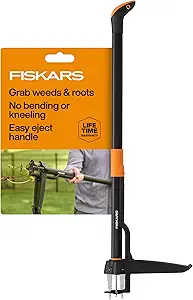
Fiskars Deluxe Stand-Up Weed Puller
- Pulls weeds root and all from standing height
- Foot-pedal claw design needs no kneeling or bending
- Ejector lever releases the weed without touching it
- Durable steel claws hold up season after season
- Heavier than a hand trowel to carry around the yard
- Struggles in very rocky or compacted soil

Grampa's Weeder Stand-Up Weed Puller
- Simple foot-bar-and-lever action, nothing to break
- No batteries or maintenance required
- Long track record as an arthritis-friendly tool
- Wood handle is comfortable and lightweight
- No ejector — weeds must be shaken off by hand
- Bulkier to store than folding tools

Flora Guard Ratchet Pruning Shears
- Ratchet mechanism cuts with a fraction of normal squeeze force
- Handles branches up to roughly ¾ inch
- Padded, non-slip grip
- Compact enough for a garden apron or bag
- Ratchet action is slower per cut than a standard bypass pruner
- Not intended for thick or woody branches

Fiskars Ergo Garden Cultivator
- Oversized, contoured grip reduces hand strain
- Lightweight aluminum head
- Good for loosening soil and light weeding around plants
- Comfortable for extended use
- Short handle still requires bending or kneeling to use
- Tines are light-duty, not for hard or rocky soil

KVR Upgraded Garden Kneeler and Seat
- Flips between a padded kneeler and a seat
- Sturdy side handles help with pushing up to standing
- Folds flat for storage
- Side pouches hold small tools
- Bulkier to carry between garden beds than a plain pad
- Weight capacity should be checked before buying
Gardening is one of the hobbies people give up reluctantly, usually not because they've lost interest but because standard tools demand exactly what arthritis takes away: a strong closing grip, the ability to kneel and get back up, and wrists that can twist without pain. The fix isn't a smaller garden — it's different tools. Our top pick is the Fiskars Deluxe Stand-Up Weed Puller, which removes the single hardest part of gardening (kneeling to pull weeds) entirely, paired with a ratchet pruner that replaces squeeze-strength with leverage for anyone who's had to give up regular shears.
The two problems that end up ending a gardening hobby
Kneeling and getting back up
Ground-level tasks — weeding, planting, deadheading low plants — are the most common reason people stop gardening, not because the tasks are hard but because getting down to ground level and back up repeatedly becomes painful or risky. The fix is either raising the task (raised beds, containers) or raising the tool (long-handled, stand-up versions of ground tools).
Grip strength for cutting and pulling
Standard pruning shears and hand tools rely on a firm, repeated squeeze — exactly the motion arthritis makes painful. Ratchet mechanisms and larger, padded grips both address this by trading squeeze-strength for leverage and surface area, so the same cut takes a fraction of the hand force.
What to actually look for
Ratchet action on pruners
A ratchet pruner cuts a branch in two or three small squeezes instead of one hard one, using a gear mechanism to multiply hand force. For anyone who's stopped pruning because it hurts, this is usually the single tool that brings it back.
Stand-up, long-handled designs
Weeders, cultivators, and even some trowels now come in stand-up versions with long handles and a foot-pedal or lever action, so weeding happens from standing height instead of a kneeling crouch.
Padded, oversized grips
Foam or rubber grips that are thicker than standard tool handles distribute pressure across the whole hand instead of concentrating it in the fingers — genuinely more comfortable for arthritic hands over a long gardening session, not just a marketing detail.
Lightweight materials
Aluminum and fiberglass handles cut the overall weight of a tool meaningfully compared to older wood-and-steel designs, which matters more the longer a task takes.
A kneeler and seat, for tasks that still require getting low
Not every task can move to standing height. A padded kneeler that doubles as a seat — with handles on the frame to push up from — makes the tasks that do require kneeling much easier to get back up from afterward.
Our picks
Fiskars Deluxe Stand-Up Weed Puller — Best for No-Bend Weeding
A foot-pedal design drives four claws into the soil around a weed's root, and a handle-operated ejector lever pulls the whole root out and releases it into a bucket or compost pile — all from standing height. This single tool eliminates the most physically demanding part of weeding for most gardeners.
Check price on AmazonFiskars Deluxe Stand-Up Weed Puller
Grampa's Weeder — Best Classic Stand-Up Design
A long-standing, simple design: step on the foot bar, rock the handle back, and the claw pulls a weed root and all. No batteries, no moving parts to break, and it's been the go-to recommendation for arthritis-friendly weeding for decades for a reason.
Check price on AmazonGrampa's Weeder Stand-Up Weed Puller
Flora Guard Ratchet Pruning Shears — Best for Weak Grip
The ratchet mechanism cuts branches up to about ¾ inch in a few light squeezes rather than one hard one, with a padded, non-slip handle. The difference in required hand force compared to standard bypass pruners is immediately noticeable.
Check price on AmazonFlora Guard Ratchet Pruning Shears
Fiskars Ergo Garden Cultivator — Best Hand Cultivator
An oversized, contoured grip and lightweight aluminum head make loosening soil around plants far less taxing on the hand than a standard cultivator's thin handle.
Check price on AmazonFiskars Ergo Garden Cultivator
KVR Upgraded Garden Kneeler and Seat
Folds flat for storage, flips between a padded kneeler and a seat, and has sturdy side handles specifically for pushing up to standing — the detail that separates a genuinely useful kneeler from one that just adds a cushion.
Check price on AmazonKVR Upgraded Garden Kneeler and Seat
Other adjustments that help as much as any single tool
- Raised beds or containers bring the whole garden up to waist or standing height, removing the kneeling problem at the source rather than working around it.
- Wide, textured tool grips wrapped with pipe insulation or grip tape can extend the life of tools already owned without buying replacements.
- Shorter gardening sessions, more often — 15-20 minutes at a time avoids the joint stiffness that comes from one long session, and most tasks don't actually need to be done all at once.
Setting up the garden itself, not just the tools
Tools solve the moment-to-moment strain of a task, but the layout of the garden determines how often that strain comes up in the first place. A few structural changes reduce the total physical demand more than any single tool purchase.
Raise the growing surface
Raised beds built to roughly waist height, or large containers on a stand, turn planting, weeding, and harvesting into standing-height tasks instead of ground-level ones. This is the highest-impact change available, since it removes the kneeling problem for an entire bed rather than working around it task by task.
Widen the paths
Paths wide enough for a rollator, wheelchair, or simply a wider stance make it easier to get close to a bed without stepping into soft soil or reaching awkwardly across a border. Firm, level path material — pavers or compacted gravel rather than loose mulch — also reduces trip risk.
Group plants by water and care needs
Clustering plants that need the same watering schedule and sun exposure cuts down on the number of separate trips and different tool changes needed during a typical gardening session, which matters more the more each trip costs in effort.
A simple session routine that avoids overdoing it
Arthritis pain often shows up hours after overexertion, not during it, which makes it easy to do too much in one session without realizing it until the next day. A working routine: start with the task that requires the most bending or gripping while joints are freshest, switch to a standing task after 10-15 minutes, and stop for the day once early stiffness shows up rather than pushing through it. Warm hands — a few minutes running warm water over them, or garden gloves with a fleece lining on cool mornings — measurably improve grip comfort and control before starting.
Frequently asked questions
Are ratchet pruners as strong as regular pruning shears?
For branches up to about ¾-1 inch, yes — the ratchet mechanism multiplies force through several small squeezes to match what a single hard squeeze does on a standard pruner. For thick, mature branches, a small pruning saw is still the better tool regardless of hand strength.
Do stand-up weeders actually get the whole root, or just the top of the weed?
A well-made claw-style weeder (like the Fiskars or Grampa's Weeder design) grips below the root crown and pulls the taproot with it for most common weeds like dandelions. Weeds that spread by shallow surface roots or rhizomes are harder for any hand tool, stand-up or not, to fully remove.
Is a raised bed worth the cost just to avoid kneeling?
If kneeling and getting back up is the main barrier to gardening, yes — it addresses the root cause rather than working around it task by task, and a modest raised bed is a one-time cost against years of easier gardening. It's worth prioritizing over buying several specialty tools if the budget only allows one investment.
What's the single best tool to start with?
A stand-up weed puller, if kneeling is the bigger obstacle, or a ratchet pruner, if grip strength for cutting is the bigger one. Most people who've stepped back from gardening find one of those two is the actual blocker, not a lack of the right trowel.
Do padded gloves help as much as padded tool handles?
Yes, and the two work together rather than one replacing the other — a well-padded glove adds cushioning underneath whatever grip the tool provides, and can make a real difference on tools that weren't specifically designed with arthritis in mind. Look for gloves with reinforced palms and a snug, not tight, fit, since loose material bunching in the palm undoes some of the benefit.
Is it worth replacing an entire toolset, or just the tools used most?
Just the tools used most, for most people and most budgets. A pruner and a weeder cover the two most physically demanding regular tasks — cutting and ground-level pulling — and upgrading those two first gives the most noticeable relief before spending on less frequently used tools like edgers or rakes.
Building up rather than giving up
The goal with any of this isn't to eliminate every physically demanding task from gardening — it's to remove the specific tasks that cause pain or genuine fall risk, so the parts of the hobby that are actually enjoyable stay available. Someone who loves deadheading roses but dreads weeding doesn't need to quit gardening; they need a stand-up weeder for the part they dread and can keep doing the part they love exactly as before. Framing it that way, tool by tool, keeps the hobby going years longer than treating any single physical limitation as a reason to stop entirely. After a session in the garden, a heating pad built for arthritis — not just any pad from the closet — helps hands and knees recover for the next day out there.


