Best Mobility Scooters for Seniors (2026): Travel & 4-Wheel Picks
The best mobility scooters for seniors in 2026 — lightweight folding travel scooters, stable 4-wheel models, and long-range picks, with a plain-English buying guide.
As an Amazon Associate I earn from qualifying purchases. We independently review products; buying through our links never costs you extra.
Best Overall
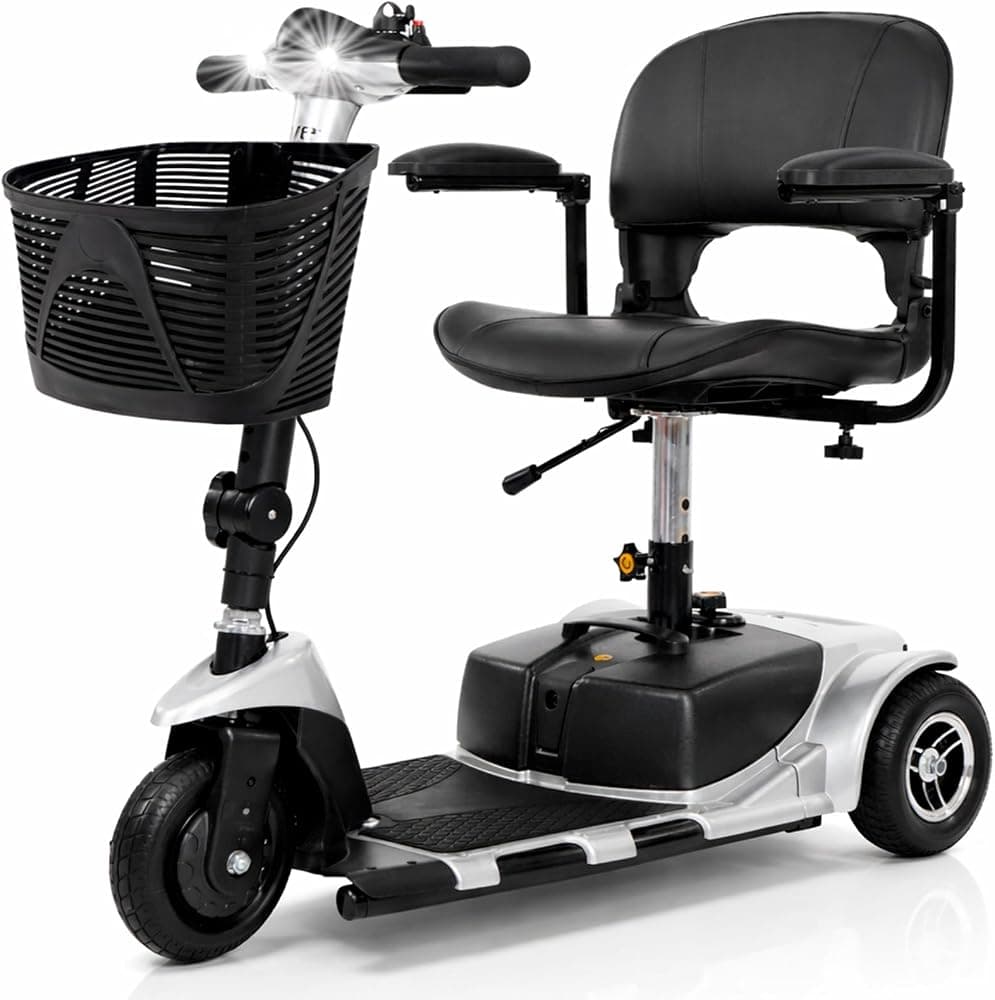
Vive 3-Wheel Mobility Scooter
Quick picks
| Product | Best for | Amazon |
|---|---|---|
| Vive 3-Wheel Mobility Scooter | Overall | Check price on Amazon |
| SuperHandy Passport Foldable 3-Wheel Scooter | Travel | Check price on Amazon |
| Rascal Venture 4-Wheel Travel Scooter | Stability | Check price on Amazon |
| Aotedor Ultra-Light Foldable Scooter | Lightest to Lift | Check price on Amazon |
| WayCare Long-Range Mobility Scooter | Range | Check price on Amazon |
Our Top Picks
Chosen for seniors based on features, specs, and verified buyer reviews.

Vive 3-Wheel Mobility Scooter
- Three wheels give a tight turning radius for indoors
- Disassembles into pieces for the car trunk
- Delta tiller is easy on arthritic hands
- LED light and front basket included
- Three wheels are less stable on rough ground than four
- Top speed suited to sidewalks, not roads

SuperHandy Passport Foldable 3-Wheel Scooter
- Folds in seconds — fits airline and cruise storage
- Airline-approved lithium battery on most configs
- Very light for a powered scooter
- Auto-fold options available
- Smaller wheels prefer smooth surfaces
- Shorter range than full-size scooters

Rascal Venture 4-Wheel Travel Scooter
- Four wheels for confident outdoor stability
- Trusted mobility brand with parts support
- Comfortable seat with armrests
- Disassembles for transport
- Wider turning circle than a 3-wheel
- Heavier pieces to lift into a car

Aotedor Ultra-Light Foldable Scooter
- Among the lightest powered scooters available
- Folds compact for trunk or closet storage
- Simple controls and quick charging
- Good for errands and travel
- Best on flat, smooth surfaces
- Limited range and top speed

WayCare Long-Range Mobility Scooter
- Long real-world range for all-day outings
- Higher weight capacity than travel models
- Larger, more cushioned seat
- Bright lights for dusk visibility
- Bulkier and heavier to transport
- Overkill for short indoor trips
For most seniors, the best mobility scooter is a lightweight 3-wheel model like the Vive 3-Wheel Scooter — it turns tightly indoors, comes apart to fit in a car trunk, and has an easy delta tiller — while a 4-wheel scooter is the better pick for outdoor stability and uneven ground. A mobility scooter restores independence for anyone who can walk short distances but tires or becomes unsteady over longer ones.
How to choose a mobility scooter
1. Three wheels or four?
Three wheels = tighter turning, better indoors and in stores. Four wheels = more stability outdoors, on grass, and on slopes. Pick based on where it will be used most.
A scooter only works if the rider can stand and pivot safely to transfer on and off the seat. If that transfer has become unsafe or exhausting, a wheelchair is usually the better fit, since it doesn't require standing to get in and out.
2. Travel/folding vs. full-size
Travel scooters fold or disassemble and are light enough to load into a car — ideal for errands, vacations, and flying. Full-size scooters ride more smoothly, go farther, and carry more weight, but they're heavy and usually need a vehicle lift.
3. Weight capacity and seat
Check the rated weight capacity and choose a seat width that's comfortable. A captain's seat with armrests is far better for longer outings than a basic bench.
4. Range and battery
Match range to your typical trip and add a margin — hills, cold, and rider weight all reduce it. If you plan to fly, confirm the battery is airline-approved.
What to look for, with senior needs in mind
Beyond the four basics above, a few details make the difference between a scooter that gets used every day and one that ends up parked in the garage. These are the things worth checking specifically for an older rider:
- The tiller and controls (dexterity and arthritis): The tiller is the handlebar you steer and accelerate with. A delta tiller — a loop-shaped bar you can push with the palm or the side of the hand — is far kinder to arthritic fingers than a thumb-only paddle that demands a firm, sustained press. If hand strength or grip is a concern, this single feature matters more than almost anything else.
- Display and readability (vision): A simple battery gauge you can read at a glance beats a busy screen. Large, high-contrast markings and clearly labeled controls help a rider who no longer sees fine print easily.
- Getting on and off (balance and joints): A swivel seat that turns toward you, plus armrests to push up from, makes mounting and dismounting far safer. A seat that's a comfortable height to stand up from — not too low — reduces the strain of every transfer.
- Weight of the heaviest piece (portability): If the scooter will travel in a car, what matters is not the total weight but the single heaviest piece someone has to lift. A caregiver with a bad back cares about that number, not the brochure's "total weight."
- Simplicity (cognition and confidence): Fewer buttons, an obvious on/off key, and a forgiving, gentle throttle response build confidence. A rider who finds the controls fussy or intimidating simply won't use the scooter, however capable it is.
- Comfort features for longer sitting: Adjustable armrests, a padded seat, and a backrest that offers real support all matter more the longer the typical outing. Swelling, back pain, and pressure points show up on a bench seat long before they do on a captain's chair.
How to choose the right one for your situation
There is no single "best" scooter — the right one depends on how and where it will be used. A few common situations:
- Mostly indoors, apartments, and stores: A compact 3-wheel scooter turns in tight aisles and doorways and stores in a small space. Stability on rough ground matters less when most travel is on smooth floors.
- Mostly outdoors, sidewalks, and uneven pavement: A 4-wheel scooter with larger wheels handles cracks, curb cuts, grass, and gentle slopes with more confidence. The wider turning circle is a fair trade for the stability.
- Frequent car trips and travel: A folding or quick-disassemble travel scooter with an airline-approved battery is the priority. Pay attention to how easily one person can break it down and lift the pieces.
- All-day outings and longer distances: A larger scooter with more range and a bigger seat pays off, provided there's a way to transport it — a vehicle lift or a spot where it lives outdoors under cover.
- A caregiver does the loading: Choose around the person doing the lifting. The lightest heaviest-piece and the simplest fold often matter more than the rider's own preferences here.
Common mistakes to avoid
- Buying more scooter than the home and car can handle. A big, comfortable, long-range model is useless if it can't get through the front door, doesn't fit down the hallway, or can't be loaded into the vehicle. Measure doorways and the trunk before buying.
- Underestimating the transfer. Families sometimes buy a scooter for someone who can no longer safely stand and pivot onto the seat. If standing has become the hard part, a wheelchair is the honest answer.
- Ignoring the battery in cold climates. Range drops sharply in winter, and a battery left in a cold garage ages faster. Plan to store and charge it indoors.
- Skipping the practice period. The first outings should be in a quiet, open space, not a crowded parking lot. Confidence with the throttle and brakes comes with a little low-stakes practice.
- Forgetting the entrance. A scooter that can't clear the front step never leaves the house. Solve the threshold at the same time you choose the scooter, not after.
Getting started and first rides
A scooter is easy to operate but still deserves a gentle introduction. A sensible first week:
- Read how the freewheel or manual-release lever works before the first ride — it lets someone push the scooter if the power ever cuts out, and it must be re-engaged before driving.
- Start indoors or in an empty driveway. Practice starting smoothly, stopping, and turning in both directions until it feels automatic.
- Learn the scooter's turning circle in a real doorway and hallway before relying on it in a store.
- Adjust the tiller angle and seat so the rider sits upright with relaxed shoulders and an easy reach to the controls.
- Charge it fully after each significant outing rather than waiting for the battery to run low; most modern batteries prefer topping up to deep discharges.
Safety tips
- Practice in an open space first; get comfortable with the throttle and braking before busy areas.
- Use lights and a flag for visibility, especially near dusk.
- Keep the battery charged and stored indoors in cold weather to protect range.
- Cross driveways and streets at a walking pace and make eye contact with drivers — a seated rider is lower and easier to miss than a standing pedestrian.
- On any slope, go straight up and straight down rather than at an angle, and avoid sharp turns on an incline where a scooter is most likely to tip.
- Keep loads in the basket, not hanging from the tiller, where they can affect steering or balance.
Frequently asked questions
How many wheels should a mobility scooter have — 3 or 4?
Choose a 3-wheel scooter if you'll mostly be indoors or in tight spaces (stores, hallways) — it turns in a much smaller circle. Choose a 4-wheel scooter for outdoor use, uneven pavement, or hills, where the extra wheel adds stability.
Are mobility scooters covered by Medicare?
Medicare Part B may cover a power scooter as durable medical equipment if a doctor documents that you need it to move around your home and can operate it safely. Coverage rules are strict, so get the prescription and a Medicare-enrolled supplier before buying.
Can you take a mobility scooter on an airplane?
Yes, but the battery is the deciding factor. Foldable 'travel' scooters with airline-approved lithium batteries (usually under 300 Wh) are the easiest to fly with. Tell the airline in advance and confirm your specific battery is allowed.
How far can a mobility scooter go on one charge?
Compact travel scooters typically go about 8–12 miles per charge; larger full-size models can reach 15–25+ miles. Real-world range drops with hills, heavier riders, and cold weather, so buy more range than you think you need.
Can a mobility scooter be used indoors?
Yes — a compact 3-wheel scooter is designed to turn in tight indoor spaces, and many people use one throughout the house. The two things to check are doorway width (measure the narrowest doorway the scooter must pass) and floor surface, since thick carpet and high thresholds are harder going than smooth floors.
How is a mobility scooter different from a power wheelchair?
A scooter is steered with a tiller (handlebars) and requires the rider to sit upright and turn to get on and off, so it suits someone who still has decent trunk strength and can transfer. A power wheelchair is steered with a joystick, offers more postural support, and turns in a tighter space, which makes it a better fit for someone who needs to stay seated most of the day or has limited upper-body strength.
What maintenance does a mobility scooter need?
Very little, but a little goes a long way: keep the battery charged and stored indoors, check that the tires are firm (or replace worn tips on solid tires), keep the seat and tiller bolts snug, and wipe it down after wet or dusty outings. If the range suddenly drops, the battery is usually the culprit and may be nearing the end of its life.
Prices and availability change often on Amazon — tap "Check price on Amazon" for each pick for current cost, specs, and verified reviews.
A scooter is only as useful as the entrances it can actually clear. our guide to sizing a home wheelchair ramp explains the ADA slope rule that determines what ramp length a given step actually needs.


