Best Digital Day Clocks for Dementia and Memory Loss (2026)
A day clock answers one question over and over without judgment: what day is it, and is it morning or night. For someone with dementia or memory loss, that single piece of orientation cuts down a lot of the anxiety that comes from not knowing. Here's what actually works and what to skip.
As an Amazon Associate I earn from qualifying purchases. We independently review products; buying through our links never costs you extra.
Best Overall
American Lifetime Day Clock
Quick picks
| Product | Best for | Amazon |
|---|---|---|
| American Lifetime Day Clock | Overall | Check price on Amazon |
| American Lifetime Day Clock XL Mahogany (15 inch) | Low Vision | Check price on Amazon |
| DayClox Updated Memory Loss Digital Calendar | Portability | Check price on Amazon |

Our Top Picks
Chosen for seniors based on features, specs, and verified buyer reviews.

American Lifetime Day Clock
- Full-word day and month display — no confusing abbreviations
- Up to 5 daily alarms for medication or appointment reminders
- Automatic night dimmer (7pm-7am) stays legible without being harsh
- 8-inch display may be small for significant low vision
- Extra buttons for caregiver settings can tempt some users to fiddle with it
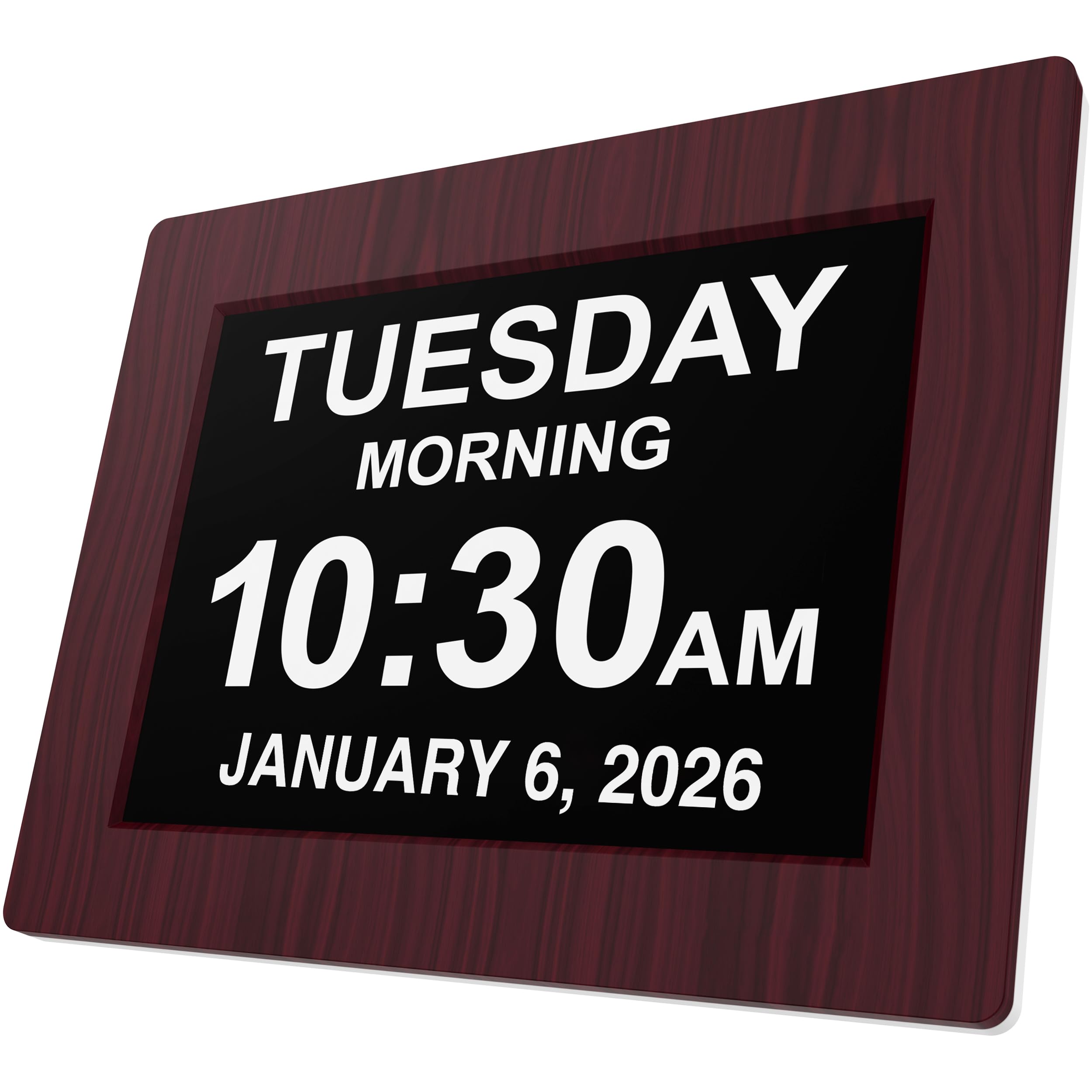
American Lifetime Day Clock XL Mahogany (15 inch)
- Nearly double the display size of the standard model
- Wood-tone housing looks less clinical on furniture
- Same full-word, non-abbreviated day/date display
- Bulkier — needs real counter or wall space
- Costs noticeably more than the standard 8-inch version
DayClox Updated Memory Loss Digital Calendar
- Easily moved between wall mount and desk/table stand
- Adjustable brightness for different rooms
- Simple, uncluttered display layout
- Fewer alarm slots than the American Lifetime models
- Stand accessory sold separately on some listings
What a Day Clock Actually Solves
A regular clock tells you the time. It doesn't tell you whether it's Tuesday or Saturday, morning or evening, or how many hours until the aide arrives. For someone living with dementia, that missing context is a real source of distress — waking up at 4 a.m. and not being able to tell if it's the middle of the night or time to get up is disorienting in a way that's hard to appreciate until you've watched it happen. A day clock is a large display, usually wall- or desk-mounted, that spells out the day of the week, the date, and a broad time-of-day label (Morning, Afternoon, Evening, Night) instead of just digits. It's a small, unglamorous device, but caregivers consistently report it cuts down on repeated "what day is it" questions and reduces nighttime confusion.
Who This Is For — and Who It Isn't
These clocks help most in the early-to-moderate stages, when a person can still read and process the display but struggles to track time and orientation independently. In later stages, when reading comprehension itself has declined, a day clock stops being useful and the household's routine and caregiving cues matter more than any device. If you're earlier in the process and mainly dealing with a parent who's still safe to be alone for stretches of the day but tends to wander at night or call at odd hours asking what day it is, this is exactly the right tool. If wandering out of the house is the bigger concern, pair this with a GPS tracker built for dementia and wandering risk — a day clock won't address that on its own.
Our Top Picks
American Lifetime Day Clock — Best Overall
This is the model most memory-care facilities and home-care agencies default to, and for good reason. The 8-inch display spells the day and month out in full words — no abbreviations — which matters because abbreviations like "WED" or "THU" are exactly the kind of shorthand that gets confusing when reading comprehension is already strained. You can set up to five daily alarms, which works well for medication times, mealtimes, or a reminder that the home health aide is coming. An automatic dimmer lowers the brightness between 7 p.m. and 7 a.m. so it doesn't light up the room at night, while staying legible enough for a 3 a.m. glance. The clock also doesn't mention dementia, Alzheimer's, or memory loss anywhere on the housing or packaging, which some families care about — it just looks like a big, clear digital clock, not a medical device.
Check price on AmazonAmerican Lifetime Day Clock
American Lifetime Day Clock XL (Mahogany, 15-inch) — Best for Low Vision
Same core function, nearly double the display size. If the person you're setting this up for also has low vision — common enough that it compounds with memory issues — the extra real estate on the 15-inch version makes a real difference from across the room, not just from a nightstand's distance. The mahogany-style housing also reads less "clinical" sitting on a dresser or side table than an all-white plastic unit, which is a small thing but one some families notice.
Check price on AmazonAmerican Lifetime Day Clock XL Mahogany (15 inch)
DayClox Updated Memory Loss Digital Calendar — Best for Portability
Functionally similar to the American Lifetime models — full-word day and date display, adjustable brightness — but built to be easily moved between a wall mount and a desk or table stand. That flexibility helps if the person splits time between a bedroom and a living room, or if a caregiver wants to test placement before committing to a permanent wall spot.
Setup Tips That Actually Matter
- Placement matters more than the model you buy. Put it somewhere the person naturally looks first thing — facing the bed, or on the wall opposite their usual chair — not tucked on a shelf.
- Turn off any redundant time zone or alarm features you don't need. Extra buttons and settings some of these clocks offer for caregiver convenience can be more confusing than helpful if the person tries to interact with the clock themselves.
- Plug it in rather than relying on battery backup as the primary power source. A day clock that goes dark after a battery dies mid-week defeats the purpose during a power blip.
- Pair it with a simple written note nearby for early stages — some families tape a card next to the clock explaining what each Morning/Afternoon/Evening/Night label means, as a bridge while the person adjusts to reading it.
Where These Fall Short
A day clock doesn't remind anyone to actually take medication — it just displays the time and can beep at an alarm time. For that, pair it with a weekly pill organizer or, if missed doses are becoming a safety issue, a locking automatic pill dispenser that won't release the next dose early. And in moderate-to-late stage dementia, don't expect a day clock to reduce sundowning or agitation on its own — it's an orientation aid, not a behavioral intervention, and some families find it stops helping once reading comprehension declines further.
Day-and-date clocks are built for orientation, not necessarily for readability at a distance. For users whose primary issue is vision rather than disorientation, our talking clocks and watches for low vision guide covers press-button voice announcement clocks instead.
What to Look For in a Day Clock
Day clocks look similar at a glance, but a few features decide whether one actually reduces confusion for someone with memory loss:
- Full words, no abbreviations. "Wednesday" and "Morning" spelled out are far clearer than "WED" or an AM/PM symbol, which are exactly the shorthand that trips up a strained reader.
- A clear time-of-day label. Displaying "Morning," "Afternoon," "Evening," or "Night" answers the most common source of nighttime distress — not knowing whether it's time to get up — better than the hour alone.
- Large, high-contrast text. Dark lettering on a light background, readable from across the room, matters because memory loss and low vision so often travel together.
- An automatic night dimmer. A screen that softens overnight stays glanceable at 3 a.m. without lighting up the whole bedroom.
- A simple, uncluttered face. Fewer buttons and no distracting extra readouts reduce the chance the person changes a setting by accident.
- Reliable mains power. A plug-in clock with battery backup won't quietly go dark mid-week the way a battery-only unit can.
How to Choose the Right One for Your Situation
- By stage: day clocks help most in early-to-moderate memory loss, when the person can still read and process the display. In later stages, routine and caregiver cues matter more than any device.
- By vision: if low vision compounds the memory issue, size up to the 15-inch XL display so it reads clearly from a chair or bed, not just up close.
- By living situation: for someone who moves between rooms, a portable model that switches between wall mount and table stand earns its place; for a fixed bedroom or living-room spot, a wall-mounted clock is simpler.
- By what feels comfortable: a wood-tone housing reads less clinical on a dresser than stark white plastic, which some families prefer for a device meant to blend into the home.
Common Mistakes to Avoid
- Placing it out of the natural line of sight. A day clock on a side shelf gets ignored; facing the bed or opposite the usual chair, it gets used.
- Leaving confusing extra features on. Turn off alarms, second time zones, or settings the person doesn't need, so there's less to accidentally change.
- Relying on battery power alone. A dead battery mid-week defeats the whole purpose; keep it plugged in.
- Expecting it to work silently. Most people need a caregiver to point at the display and read it aloud together for a few days before checking it becomes a habit.
- Expecting too much of it. A day clock is an orientation aid, not a treatment for sundowning, wandering, or missed medication — pair it with the right tool for those separate problems.
Frequently Asked Questions
Will a day clock reduce sundowning?
Not directly — sundowning is a separate phenomenon tied to circadian and environmental factors. A day clock can reduce the specific anxiety that comes from not knowing what time or day it is, which sometimes overlaps with sundowning symptoms, but it isn't a treatment for it.
Do I need to explain the clock to my parent, or will they figure it out?
Most caregivers report a short adjustment period — a few days to a couple of weeks — of pointing at the display and reading it aloud together before it becomes a habit to check independently. It rarely works as a silent, unexplained addition to the room.
What size display should I get?
The 8-inch American Lifetime clock is legible from about 10-15 feet for most people. If vision is a bigger factor than memory, size up to the 15-inch XL version.
Where's the best place to put a day clock?
Somewhere the person naturally looks first — facing the bed for the morning glance, or on the wall opposite their usual chair during the day. Placement matters more than which model you buy; a clock that's out of the natural line of sight tends to go unnoticed no matter how clear the display.
Will my parent be able to set it up themselves?
Usually it's best for a caregiver or family member to handle the one-time setup and then leave the settings alone. The person using it only needs to read the display, not operate it, and reducing the number of buttons they interact with lowers the chance of an accidental change that causes confusion.
Does it need Wi-Fi or a phone app?
No. These are standalone clocks that plug into the wall and display the day, date, and time-of-day on their own — there's nothing to connect, sync, or troubleshoot, which is part of what makes them low-stress for both the person and the caregiver.
Can a day clock also remind about medication?
Some models have alarm slots that can beep at set times, but a day clock doesn't dispense pills or confirm a dose was taken. For that, pair it with a weekly pill organizer, or a locking automatic dispenser if missed doses have become a safety concern.
The Bottom Line
For early-to-moderate dementia or general memory-loss disorientation, a day clock is one of the cheapest, least intrusive interventions available — it just answers "what day is it" before the question turns into distress. Go with the standard American Lifetime Day Clock for most households, size up to the XL if low vision is also a factor, and don't expect it to replace medication reminders or wandering-safety tools that are solving different problems.

