Best Emergency Weather Radios for Seniors (2026): NOAA Alerts That Work When the Power Doesn't
Hand-crank and solar NOAA weather radios that keep working when a storm takes out the power, the Wi-Fi, and cell service at the same time — which model to buy, how long the battery actually lasts, and why a phone app isn't a substitute.
As an Amazon Associate I earn from qualifying purchases. We independently review products; buying through our links never costs you extra.
Best Overall
Midland ER310 Emergency Crank Weather Radio
Quick picks
| Product | Best for | Amazon |
|---|---|---|
| Midland ER310 Emergency Crank Weather Radio | Overall | Check price on Amazon |
| Midland ER310PRO Emergency Radio | Longest Runtime | Check price on Amazon |
| Sangean MMR-88 Emergency Radio | Reception | Check price on Amazon |

Our Top Picks
Chosen for seniors based on features, specs, and verified buyer reviews.
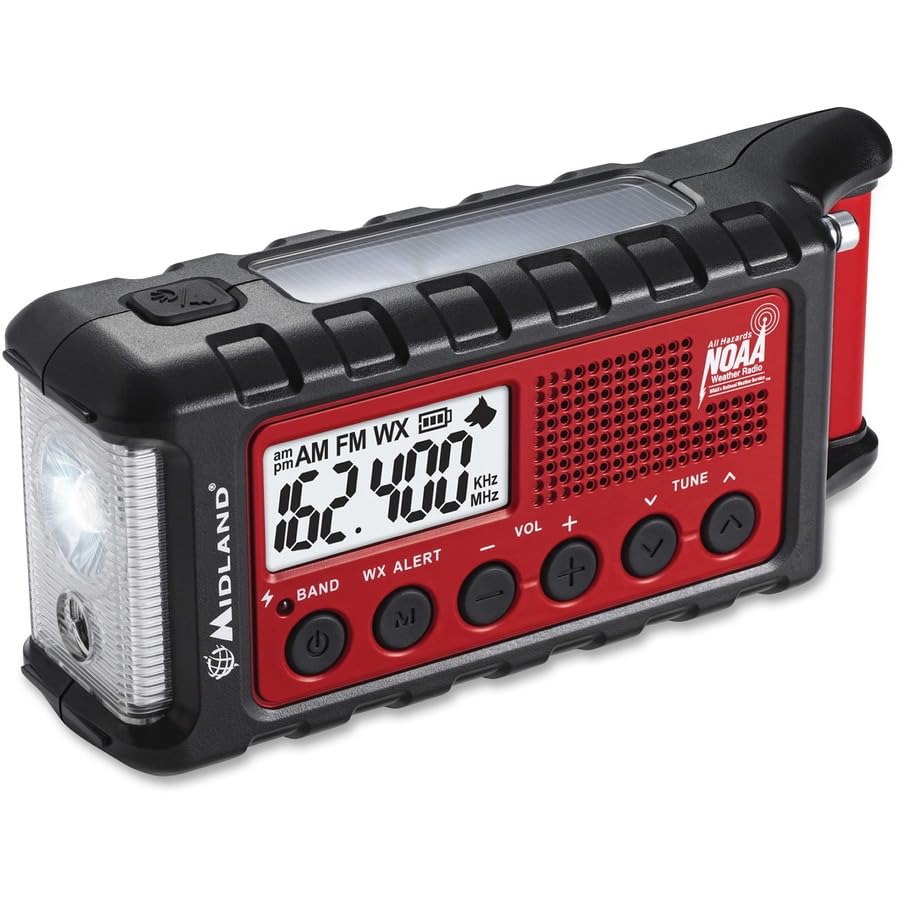
Midland ER310 Emergency Crank Weather Radio
- Five power sources: hand crank, solar, AAA batteries, USB, rechargeable battery
- Automatic NOAA weather alerts for a registered county
- Comfortable, large crank handle singled out by independent reviewers as easy to use
- Budget-friendly for the features included
- Base internal battery runtime is modest without cranking or sun
- No Bluetooth on the base model

Midland ER310PRO Emergency Radio
- Roughly 3x the battery capacity of the standard ER310
- Rated for 200+ hours of radio use per charge
- Stronger built-in power bank for charging phones
- Adds Bluetooth speaker function
- Costs more than the base ER310
- Larger and heavier to store
Sangean MMR-88 Emergency Radio
- Noticeably cleaner AM/FM/NOAA reception than budget radios
- Receives all seven NOAA weather channels
- Digital display and tuner, easier to read than analog dials
- IPX3 water resistance
- Pricier than bare-bones budget radios
- Hand-crank charging is slower than dedicated crank-first designs
The Short Answer
The Midland ER310 is the best emergency weather radio for most seniors: it runs on five power sources (hand crank, solar panel, AAA batteries, USB, and a built-in rechargeable battery), pulls in automatic NOAA weather alerts. If the goal is running as long as possible through a multi-day outage, the upgraded Midland ER310PRO carries roughly three times the battery capacity and doubles as a stronger phone charger. If clear reception matters more than extra features, the Sangean MMR-88 pulls in AM, FM, and all seven NOAA weather channels more cleanly than most radios near its price.
Why This Belongs on the Emergency Shelf, Not Just the Prepper's
A weather radio sounds like gear for storm chasers, but the actual audience for one is anyone who depends on electricity for something medical: a CPAP machine, a motorized wheelchair, a hearing aid charger, an oxygen concentrator, or simply a phone that a medical alert pendant relies on to call for help. When a storm knocks out power, the first hours are the most dangerous ones — that's when people decide whether to stay put, evacuate, or wait it out, usually without knowing how long the outage will last or whether conditions are getting worse. A dedicated radio answers that question without needing cell service, home Wi-Fi, or a charged phone, which are exactly the three things a bad storm tends to take out first.
It also solves a specific problem for anyone living alone: knowing when to worry. A radio that automatically switches on and sounds an alert the moment the National Weather Service issues a warning for the local county means nobody has to remember to check anything at 2 a.m. That's a meaningfully different experience than a phone weather app, which requires someone to think to open it.
What Actually Matters When Choosing One
- Multiple charging methods. A radio that only takes disposable batteries is a radio that stops working the moment the batteries run low and the store is closed. Look for at least three independent power sources — hand crank, solar, and USB rechargeable — so no single failure leaves it dead.
- Automatic weather alerts, not just a weather band. Every radio with a weather band lets someone manually tune to NOAA and listen. Fewer radios will automatically wake up and sound an alarm when the National Weather Service issues a warning for the registered county — that's the feature that matters at night.
- A speaker loud enough to hear across a room. Radios built for backpacking prioritize small size over volume. For home use, a bigger speaker that can be heard from another room, especially by someone with hearing loss, matters more than compactness.
- Large, distinct buttons. Some budget radios cram tuning, alert, and power functions onto tiny multi-function buttons that are hard to operate by feel in the dark during a power outage — exactly when it will actually get used.
- A real USB port for charging a phone. The best models double as a backup battery for a phone, which matters enormously if that phone is what triggers a medical alert call or a family check-in text.
Our Picks
Midland ER310 — Best Overall
The ER310 covers the fundamentals better than almost anything else at its price: hand crank, solar panel, AAA battery backup, USB charging, and a 2,600 mAh internal battery, all built around automatic NOAA weather alerts for a registered county. In testing by outdoor gear reviewers, 60 seconds of cranking produced about 26 minutes of radio playback, and the crank handle was rated the most comfortable of the radios tested — a real consideration for anyone with arthritis or reduced hand strength. It also includes a flashlight and a red emergency beacon, both genuinely useful during a nighttime outage rather than gimmicks.
Midland ER310PRO — Best for Running Longest
Midland's upgraded model swaps in a lithium-ion battery rated for roughly three times the capacity of the standard ER310 — over 200 hours of radio use on a full charge, according to Midland — and adds Bluetooth speaker functionality and a stronger built-in power bank for charging phones. It costs somewhat more than the base ER310. For a household that has weathered a genuine multi-day outage before and knows the standard model's runtime wasn't enough, the PRO closes that gap; for most people, it's a nice-to-have rather than a necessity.
Sangean MMR-88 — Best Reception
The MMR-88 is built by a company with a long radio-manufacturing history, and it shows in reception quality — reviewers consistently rate its AM, FM, and NOAA weather-band pickup as noticeably cleaner than budget alternatives, with access to all seven NOAA weather channels rather than just the strongest local one. It also has a digital display and tuner, which is easier to read and operate precisely than the analog dial many crank radios still use. It runs on battery, solar, or hand crank, with an IPX3 water-resistance rating that the Midland models don't advertise. It costs more than a bare-bones budget radio, and its hand-crank charging is slower than a dedicated crank-first design, but for anyone who plans to actually listen to AM/FM programming day to day — not just during emergencies — the extra clarity is worth it.
Check price on AmazonSangean MMR-88 Emergency Radio
A Weather Radio vs. Just Using a Phone
The honest question is why not just rely on a phone's weather app and emergency alerts, since almost everyone already carries one. The answer comes down to what fails first in a real storm. Cell towers run on grid power with limited battery backup, typically a matter of hours, and can go down entirely in a severe storm even when the phone itself still has charge. NOAA Weather Radio, by contrast, broadcasts from a network of transmitters specifically built for emergency communication, with backup generators designed to keep broadcasting through the exact conditions that take down cell service. A phone is the more convenient tool on a normal day; a dedicated radio is the tool that's still working on the day the phone isn't.
There's a second, quieter benefit: a radio doesn't need a data plan, a working account, or a charged phone battery that's already been drained by hours of flashlight use and worried phone calls to family. It's one less thing competing for a shrinking battery during exactly the hours when that battery matters most.
How Long Should It Actually Run?
Runtime estimates on the packaging assume ideal conditions, so it helps to think in ranges. The base Midland ER310 realistically provides several hours of radio playback on a full charge from its internal battery, plus roughly 20-30 minutes of additional playback per 60 seconds of hand cranking — useful, but it means someone genuinely will be cranking a radio for stretches during a multi-day outage. The ER310PRO's roughly triple capacity turns that into a device that can run through a full overnight outage without any cranking at all, which matters if the person using it has limited hand strength or mobility. Solar charging supplements both models during daylight but shouldn't be counted as a primary source, since cloud cover during a storm is common and unpredictable.
Where to Keep It, and When to Test It
A weather radio that's still in its box in a closet during an actual outage is functionally useless. It belongs somewhere it will actually be reached in the dark — a nightstand drawer, a kitchen counter near where medications are kept, or wherever a home safety kit already lives. Test it on a fixed schedule, not "whenever it comes to mind" — the first of the month is an easy anchor. Testing means actually cranking it for a minute, confirming the flashlight works, and checking that the weather-alert setting is still tuned to the correct county, since a move or a firmware reset can silently clear that setting.
Common Mistakes to Avoid
- Buying a radio with only one power source. A battery-only radio is a radio that's dead the one week batteries weren't restocked. Redundancy is the entire point.
- Never testing it until the day it's needed. A radio with a dead internal battery from months of storage, discovered for the first time during an actual outage, defeats the purpose entirely.
- Skipping the county alert setup. Automatic alerts only work if the radio is programmed for the right county code — an out-of-the-box radio usually isn't set up yet.
- Treating it as a phone-charging afterthought. The built-in USB port is one of the more valuable features during an outage; make sure a charging cable lives with the radio, not buried in a drawer elsewhere.
- Storing it somewhere hard to find in the dark. If it takes searching by flashlight to locate the radio, it's in the wrong spot.
Frequently Asked Questions
Do I need a weather radio if I already have a smart speaker like an Echo Show?
A smart speaker is genuinely useful day to day, but it depends on home Wi-Fi and grid power — both of which a bad storm can take out at the same time. A crank or solar radio keeps working when the internet and the power both go down, which is exactly the scenario a weather radio is built for.
How often does the battery need to be replaced?
The internal rechargeable battery in models like the ER310 is built to last for years of normal use, but it slowly self-discharges in storage. A monthly test-crank and charge keeps it topped off; a radio left completely untouched for a year may need a longer initial charge before it holds power reliably again.
Can it replace a medical alert device?
No. A weather radio tells you what's happening outside; it doesn't call for help. That's a separate job handled by a medical alert system. The two solve different problems and work well kept together in the same emergency-ready spot.
Is the hand crank hard to use with arthritis?
It varies by model. The Midland ER310's crank handle was specifically noted by independent outdoor-gear reviewers for its comfortable, large grip, which matters more than crank speed for someone with reduced hand strength. If cranking is a concern, prioritizing solar and USB charging over relying on the crank is a reasonable workaround — or stepping up to the ER310PRO's larger battery so cranking is rarely necessary at all.
Will it work during a hurricane or wildfire evacuation, not just a home power outage?
Yes — that's the scenario these radios are built for first. The solar and crank charging matter most away from outlets, and the compact size means it travels easily in a go-bag alongside medications and copies of important documents.
The Bottom Line
Get the Midland ER310 for the best balance of price, redundant power sources, and automatic alerts. Step up to the ER310PRO if a household has weathered a real multi-day outage before and wants more runtime without relying on cranking. Choose the Sangean MMR-88 if clean AM/FM reception for daily listening matters as much as the emergency features. Whichever one gets bought, the radio that matters is the one that's actually tested, charged, and easy to find in the dark — not the one still sealed in its box.


