Best Magnifiers for Seniors with Low Vision (2026): Reading, Labels, and Hobbies
A magnifier for reading the newspaper and one for reading a medication label are not the same product. Four picks by use case — handheld, hands-free, and stationary — plus the LED detail that matters more than magnification power.
As an Amazon Associate I earn from qualifying purchases. We independently review products; buying through our links never costs you extra.
Best for Everyday Reading
Recant LED Lighted Handheld Magnifier
Quick picks
| Product | Best for | Amazon |
|---|---|---|
| Recant LED Lighted Handheld Magnifier | Everyday Reading | Check price on Amazon |
| JMH 30X LED Magnifying Glass | Fine Detail | Check price on Amazon |
| MagniPros 3X Head-Mounted Magnifier with LED | Hands-Free Option | Check price on Amazon |
| Brightech LightView Pro LED Magnifying Floor Lamp | Stationary Option | Check price on Amazon |

Our Top Picks
Chosen for seniors based on features, specs, and verified buyer reviews.
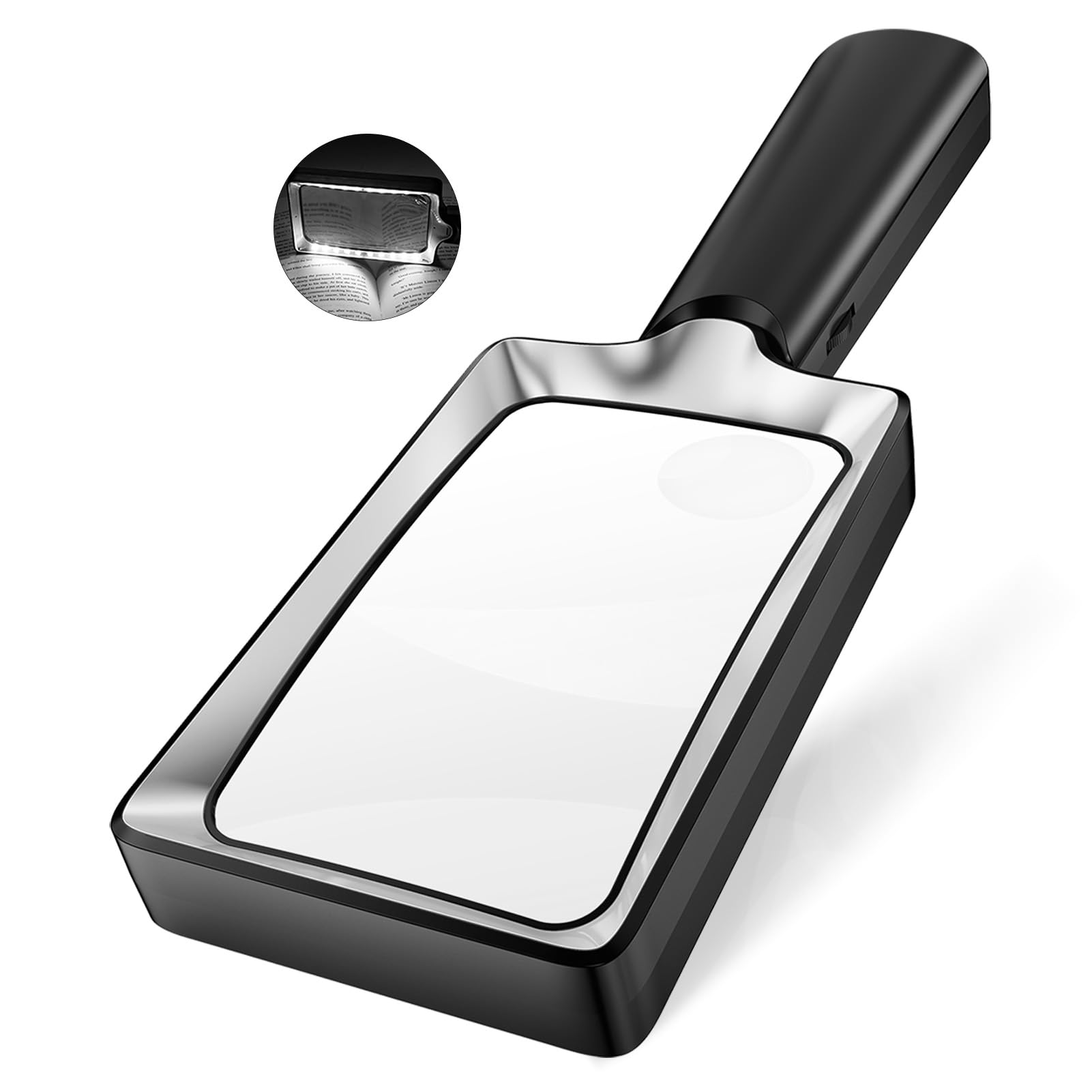
Recant LED Lighted Handheld Magnifier
- 4.33-inch acrylic lens with dual magnification levels
- 20 non-glare LEDs with stepless 0–100% brightness dimming
- Lightweight (6.7 oz) for long holding sessions
- Not hands-free — still requires one hand to hold
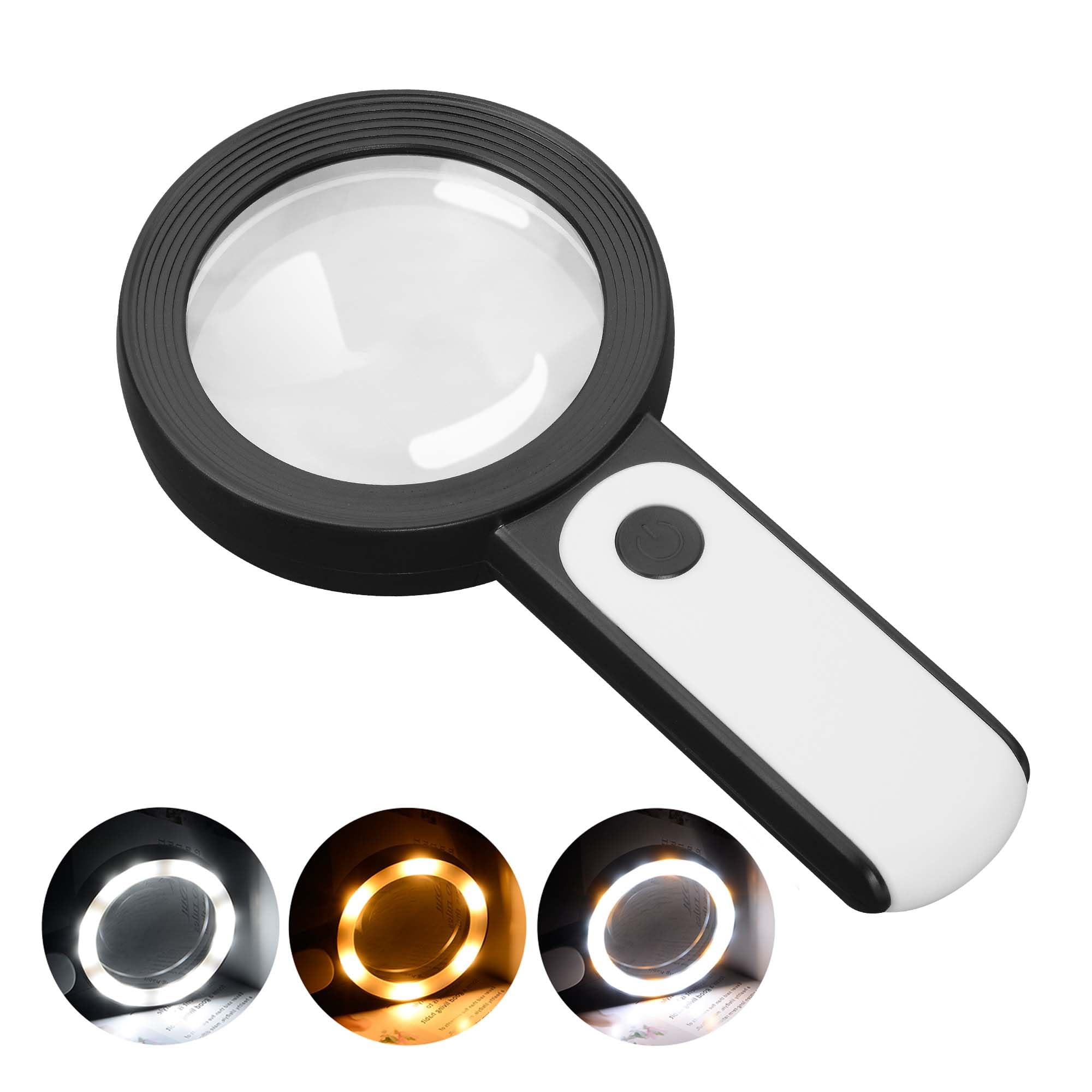
JMH 30X LED Magnifying Glass
- 30X zoom with a large 3.15-inch lens
- 18 LEDs with three color modes (cold, warm, mixed) to reduce eye strain
- Good for small print like ingredient lists or fine hobby work
- High zoom narrows the field of view — slower to scan a full page
- Better suited to spot-checking than sustained reading
MagniPros 3X Head-Mounted Magnifier with LED
- Frees both hands for sewing, crafts, or eating while reading a recipe
- Flip-up lenses so it doesn't have to come off between tasks
- Built-in LEDs for close-up work in dim light
- Takes some getting used to wearing on the head
- Not ideal for reading while walking around

Brightech LightView Pro LED Magnifying Floor Lamp
- Full hands-free reading from a favorite chair — no holding or wearing anything
- Large lens with bright, even LED ring light
- Adjustable arm positions the lens exactly where needed
- Not portable — stays wherever it's set up
- Larger upfront cost than a handheld
Magnification Power Isn't the Spec That Matters Most
It's tempting to shop by the biggest zoom number — 20X, 30X — but for macular degeneration or general age-related vision loss, lighting quality usually matters more than raw magnification. A high-zoom lens with weak or uneven lighting throws a shadow right where the eye needs to focus, which is why the better current magnifiers lead with LED count and brightness control rather than zoom alone. LED lights also run cool and last roughly 100,000 hours, so unlike older incandescent magnifier lamps, they don't heat up in the hand during a long reading session.
Match the Magnifier to the Task
- Medication labels and mail: a compact handheld magnifier with a bright, even LED ring — something that lives in a kitchen drawer, not a hobby room.
- Newspapers, books, long reading sessions: a hands-free option (head-worn or a magnifying lamp) so the arm doesn't tire holding a lens for 20 minutes.
- Sewing, jewelry, model-building: higher zoom with a stand or head mount, so both hands stay free for the actual task.
Buying one magnifier to cover all three is possible but usually means compromising on the one used most often — for most seniors, that's reading, so we'd lead with the handheld LED pick or the lamp before the head-worn or high-zoom options.
Our Top Picks
These four cover the handheld, hands-free, and stationary-lamp use cases above rather than being four versions of the same product.
A Note on Medication Labels Specifically
If the real problem is reading pill bottles and organizer labels rather than general reading, it's worth checking whether a weekly pill organizer with larger printed day labels solves it more directly than a magnifier alone — the two pair well together (magnifier for the fine print, organizer for the daily routine), but a magnifier shouldn't be the only fix if the real issue is a cluttered, hard-to-read bottle label.
Where Magnifiers Fall Short
None of these replace a proper eye exam or address the underlying cause of vision loss — they compensate for it. If reading has gotten noticeably harder over a period of months rather than staying steady, that's worth a visit to an eye doctor before assuming a stronger magnifier is the fix. And for screen reading specifically (not print), a tablet's built-in text-size and zoom settings often do more than a physical magnifier held up to a screen, which tends to catch glare.
Budgeting for More Than One
Most households shopping for a senior end up buying two magnifiers eventually, not one — a handheld for the kitchen and mail, plus whichever hands-free option fits the hobby. That's normal and worth planning for upfront rather than assuming one purchase will cover every use case; a $15 handheld and a $60 head-mounted magnifier together still cost less than a single premium lamp, and they solve two different problems instead of compromising on both.
For checking the time specifically, a magnifier isn't always the fastest option — our talking clocks and watches guide covers devices that announce the time out loud instead.
What to Look For Beyond Zoom
Since lighting and field of view matter as much as raw power, weigh these senior-specific factors when comparing magnifiers:
- LED count and brightness control. A ring of evenly spaced LEDs lights the page without the hot spot and shadow a single bulb creates. A dimmer is genuinely useful, because glossy magazine pages and glare-prone labels need less light than a dull paperback.
- Lens size versus lens power. A larger lens shows more of the line at once, which makes scanning far easier; a small very-high-power lens shows only a few letters at a time. For sustained reading, a bigger, more modest-power lens usually wins.
- Weight and grip. A heavy handheld becomes tiring within a few minutes. A lightweight body, or a thick, easy-to-hold handle, matters for anyone with arthritis or reduced grip strength.
- Distortion at the lens edge. Cheaper acrylic lenses blur or bend text near the rim. A quality lens stays clear edge to edge, so the reader isn't constantly re-centering the page.
- Power source that fits the person. Replaceable AAA batteries last a long time but require occasional swaps; a rechargeable USB model spares someone who struggles with small battery doors, at the cost of remembering to charge it.
How to Choose the Right One for Your Situation
- By vision level: for mild to moderate age-related loss, a bright 3–5X handheld covers most everyday reading. Reserve very high power for spot-checking tiny print, not full pages.
- By main task: quick label and mail checks favor a pocket or drawer handheld; long reading favors a lamp or head-worn unit that spares the arm; close hobby work favors a stand or head mount that frees both hands.
- By dexterity: shaky or arthritic hands do better with a hands-free lamp or head magnifier than with a handheld that has to be held steady over the line.
- By setting: someone who reads in one favorite chair is well served by a floor-lamp magnifier parked beside it; someone who reads all over the house needs something portable.
Getting Started and Using a Magnifier Well
A magnifier works best with technique, not just the right hardware. Hold a handheld lens closer to the page and move your eye closer to the lens to widen the view, rather than holding it far away where the image shrinks and distorts. Position any light so it falls on the page, not into the eyes, and angle glossy surfaces slightly to kill reflections. For a head-worn magnifier, expect a short adjustment period — the focal distance is fixed, so you learn to hold work at the spot where it's sharp. Above all, pair any magnifier with good general room lighting; a magnifier supplements task light, it doesn't replace a well-lit room.
Common Mistakes to Avoid
- Chasing the highest zoom number. Too much power on a small lens narrows the field so much that reading becomes slow and frustrating.
- Ignoring lighting. Many "I need a stronger magnifier" complaints are really "I need better light" — a lit magnifier or a brighter room often solves it.
- Buying one magnifier for every task. Reading the mail and doing fine needlework are different jobs; most households end up better served by two purpose-fit tools than one compromise.
- Overlooking weight. A magnifier that's comfortable for ten seconds in a store can be tiring over a twenty-minute reading session at home.
- Skipping the eye exam. A magnifier compensates for vision loss; it doesn't diagnose or treat the cause. Worsening vision warrants a professional look first.
Frequently Asked Questions
Will a phone camera's zoom work as well as a dedicated magnifier?
For a quick one-off read, yes — most smartphone cameras zoom and have a flashlight for extra light. For regular daily use, a dedicated magnifier is faster to grab, doesn't require unlocking a phone or opening an app, and the LED ring lighting is more even than a phone's single flash, which tends to create a bright hot spot and shadow the rest of the page.
Do lighted magnifiers need to be recharged, or do they run on batteries?
Most handheld and head-worn LED magnifiers run on replaceable batteries (often AAA), not a built-in rechargeable cell — check the listing before buying if a specific person struggles with battery swaps, since a rechargeable USB model may be easier for them even though batteries last longer between changes on most units.
What magnification is right for macular degeneration specifically?
There's no single right number — it depends on how much central vision loss there is, which is something a low-vision specialist can assess directly. As a starting point, most people with moderate age-related macular degeneration do better with a 3–5X lens and strong, even lighting than they do with a very high-zoom lens, since the higher the zoom, the smaller the field of view gets.
Can a magnifier help with using a smartphone or tablet screen?
Not well — holding a glass or plastic lens up to a glossy screen usually just adds glare. It's better to use the device's own accessibility settings (larger text, zoom gestures, bold text) than to magnify a screen externally; see our note on this above.
How do I know if it's the magnifier or the lighting in the room that's the problem?
Try the same task — reading a label, say — right next to a bright window during the day. If it's noticeably easier there than under the room's regular lighting, the fix might be better task lighting rather than a stronger magnifier; a magnifying lamp effectively solves both at once.
Are handheld or hands-free magnifiers better for arthritis?
Hands-free options — a magnifying floor lamp or a head-worn magnifier — are usually easier for anyone with arthritis or a hand tremor, since there's no lens to hold steady over the line. A handheld still has a place for quick, occasional checks, but for daily reading a hands-free design reduces strain.
Will a stronger magnifier always help more?
No. Beyond a certain point, more magnification shrinks the field of view so much that only a few letters are visible at once, which makes reading slower and more tiring, not easier. Matching modest magnification with strong, even lighting usually beats a very high-power lens for everyday reading.
Can one magnifier work for both reading and hobbies?
It can, but it usually means compromising on whichever task is done most. A bright handheld or lamp suits reading; a higher-power stand or head magnifier suits close hobby work. Because they solve different problems, many people find two modest magnifiers more useful than one expensive do-everything model.
Do lighted magnifiers get hot during long use?
Modern LED magnifiers stay cool even over a long reading session, which is one advantage over the older incandescent magnifier lamps that warmed up in the hand. That makes them comfortable for extended reading without any burn or heat concern.
The Bottom Line
Buy for the task, not the zoom number: a bright, even LED handheld for everyday reading and labels, a head-worn or lamp option if hands need to stay free, and don't assume higher magnification is automatically better — too much zoom on a small lens actually narrows the field of view and makes scanning a page harder, not easier. And if the real issue is a specific product's small print — remote buttons, appliance dials, TV settings — check whether a purpose-built fix exists first; our guide to large-button TV remotes is one example of solving the print-size problem at the source instead of adding a magnifier on top. And if the goal is reading messages, photos, or apps on a screen rather than physical print, a handheld magnifier isn't the right tool at all — our tablets for seniors with low vision guide covers which devices have strong enough built-in zoom and screen-reader software to handle that instead.


