Best Robotic Companion Pets for Seniors with Dementia (2026)
Robotic and lifelike plush companion pets are a genuine, well-studied option for seniors with dementia who can no longer safely care for a live animal but still benefit from the comfort of one. Here's what's real, what it costs, and who each option actually fits.
As an Amazon Associate I earn from qualifying purchases. We independently review products; buying through our links never costs you extra.
Best Overall
Joy For All Companion Pet Cat (Orange Tabby)
Quick picks
| Product | Best for | Amazon |
|---|---|---|
| Joy For All Companion Pet Cat (Orange Tabby) | Overall | Check price on Amazon |
| Joy For All Companion Pet Pup (Golden) | Dog Lovers | Check price on Amazon |
| Joy For All Companion Pet Cat (Silver with White Mitts) | a Realistic Look | Check price on Amazon |
| Perfect Petzzz Black Lab | Budget / Simplest | Check price on Amazon |

Our Top Picks
Chosen for seniors based on features, specs, and verified buyer reviews.
Joy For All Companion Pet Cat (Orange Tabby)
- Responds to petting with realistic purring, meowing, and movement
- D batteries last months, not days, with no feeding or vet visits required
- Widely studied and recommended in memory care settings
- Costs more than a simple stuffed animal
- Not waterproof or machine-washable
- Some individuals may not connect with it, and reactions can't be predicted in advance
Joy For All Companion Pet Pup (Golden)
- Barks, wags its tail, and includes a comforting heartbeat vibration
- Same durable, months-long battery life as the cat
- Strong emotional fit for lifelong dog owners
- Similar price to the cat, on the higher end of this category
- Larger and heavier than the cat, which some users prefer and others don't
- Limited coat color options compared to real dog breed variety
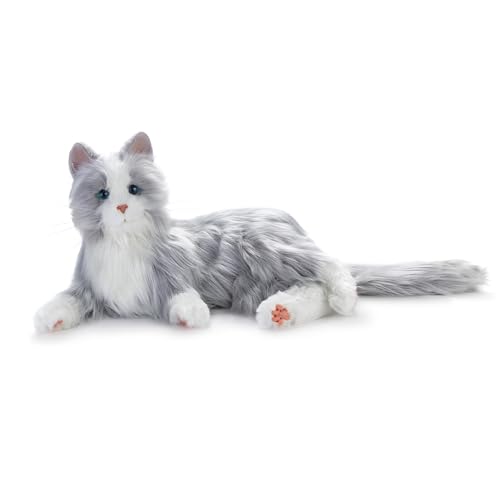
Joy For All Companion Pet Cat (Silver with White Mitts)
- Same interactive purring and meowing technology as the Orange Tabby
- Classic house-cat coloring that closely matches many remembered pets
- Consistent, reliable performance across the Joy For All lineup
- No functional difference from other Joy For All cat colors, only appearance
- Same price range as other Joy For All pets
- Availability of specific coat patterns can vary by retailer
Perfect Petzzz Black Lab
- No buttons or touch-response electronics to learn — just a continuous breathing motion
- Typically the lowest-cost option in this category
- Comes with a small bed, collar, and grooming brush for an added care routine
- No interactive response to petting, sound, or movement
- Breathing motion runs about two months per battery activation, then needs restarting
- Less emotionally realistic for users who respond well to interactive features
The Short Answer
For most families, the Joy For All Companion Pet Cat is the best starting point — it responds to petting and motion with realistic purring and meowing, needs no ongoing care, and has held up well in years of use in memory care settings. For someone who identifies more as a dog person, the Joy For All Companion Pet Pup offers the same interactive technology with a bark, a wagging tail, and a heartbeat vibration under its fur. For a lower-cost option, or for someone in a later stage of dementia where a simpler, non-electronic pet is a better fit, the Perfect Petzzz breathing plush line offers a gentler, quieter alternative without any of the buttons or interactivity of the Joy For All line.
Why This Is a Real Category, Not a Gimmick
Robotic companion pets for people with dementia aren't a novelty product — they're a documented, researched approach to a specific problem: a senior who has cared for pets their whole life often still wants and benefits from that companionship, but a live animal that needs to be fed, let outside, and vet visits is genuinely unsafe to leave with someone who can no longer reliably manage those responsibilities, and a live pet can also become a fall hazard underfoot. The Joy For All line has won recognition including the Dementia Society of America's Dementia SMART Award and a Caregiver Friendly Award from Today's Caregiver, and its maker, Ageless Innovation, was originally a Hasbro initiative built specifically around this need before spinning off as its own company. The core idea isn't to trick anyone into thinking it's a live animal — most users understand it's not — it's that the physical act of petting something warm and responsive, and the routine of caring for it, provides real comfort and can reduce agitation and loneliness regardless of whether the person fully registers that it's not alive.
What to Look For
- Realistic response to touch — purring, barking, or movement that reacts to petting and motion, rather than a fixed pre-recorded loop, keeps the interaction feeling alive rather than repetitive.
- No ongoing maintenance burden. Battery life measured in months rather than days, and no feeding, cleaning, or vet visits — the entire point is companionship without caregiving responsibility.
- Washable or wipeable fur, since these get held, hugged, and set down on furniture and floors regularly.
- A weight and size that feels like holding a real pet — too light and it feels like a toy, which can undercut the emotional connection for some users.
- Simplicity of interaction. No settings menus, no apps, no charging schedule to manage — turning it on (or nothing at all, for the breathing plush option) should be the entire learning curve.
Our Top Picks
Joy For All Companion Pet Cat — Best Overall
Available in Orange Tabby, Silver with white mitts, and other coat patterns, the Companion Pet Cat uses what Ageless Innovation calls VirbaPurr technology — a purr that responds to touch and continues at a realistic rhythm, along with meowing and repositioning when held or petted. It runs on D batteries with a runtime measured in months of typical use, not days, and the fur is soft and lifelike enough that many caregivers report it holds up to repeated hugging and handling well. It's the most-studied and most widely recommended option in this category, and a reasonable default first purchase for a family testing whether this kind of companion pet resonates with their parent.
Check price on AmazonJoy For All Companion Pet Cat (Orange Tabby)
Joy For All Companion Pet Pup — Best for Dog Lovers
The Pup uses the same underlying interactive technology as the cat, adapted for dog behavior: it barks, wags its tail, and includes a heartbeat vibration under the fur that many caregivers describe as one of the more genuinely comforting details of the whole product line — it's the kind of thing that's noticeable specifically when held against the chest. It comes in coat variations including Golden and Freckled Pup. For someone who was a lifelong dog owner, this tends to land better emotionally than the cat, and it's worth choosing based on the specific animal the person actually had or loved rather than defaulting to whichever is cheaper.
Joy For All Companion Pet Cat (Silver with White Mitts) — Best for a More Realistic Look
Functionally identical to the Orange Tabby cat above, the Silver coat pattern is worth calling out on its own because coat choice matters more than it might seem for this product category — families report that a color and pattern that closely resembles a specific pet the person had, or generally reads as more "classic house cat," gets a stronger emotional response than a novelty pattern. If there's a known preference (a childhood cat, a recently lost pet), matching the coat as closely as possible is worth the small extra effort of picking a specific variant over grabbing whatever's in stock.
Check price on AmazonJoy For All Companion Pet Cat (Silver with White Mitts)
Perfect Petzzz — Best Budget / Simplest Option
Perfect Petzzz takes a different, lower-tech approach: rather than an electronic response to touch, these are weighted, realistic plush animals — available as cats and several dog breeds including Golden Retriever, Black Lab, and Maltese — with a battery-powered breathing motion that runs continuously for roughly two months once activated, plus a soft heartbeat-like sound in some models. There are no buttons to press and no motion-response electronics to learn, which makes it a genuinely simpler option for someone in a more advanced stage of dementia, or for a family that wants to try this category at a lower price point before considering the more expensive Joy For All line. It typically costs noticeably less than the Joy For All pets, and each comes with a small pet bed, collar, and grooming brush that some caregivers find useful as an additional, calming care-routine activity.
Comparison at a Glance
| Pet | Interaction | Power | Best For |
|---|---|---|---|
| Joy For All Companion Pet Cat | Responds to petting: purrs, meows, moves | D batteries, months of runtime | Most users, especially cat people |
| Joy For All Companion Pet Pup | Barks, wags tail, heartbeat vibration | D batteries, months of runtime | Lifelong dog owners |
| Joy For All Cat (Silver) | Same as Orange Tabby cat | D batteries | Matching a remembered pet's coloring |
| Perfect Petzzz | Continuous breathing motion, no touch-response | D battery, ~2 months per activation | Later-stage dementia, simplest option, tighter budget |
How to Introduce One Without It Feeling Forced
How a companion pet is introduced matters as much as which one is chosen. Presenting it directly as "a robot cat" can undercut the whole point for some users, while others do better with full transparency about what it is — this really does depend on the individual and the stage of dementia, and there's no single right approach. What tends to work broadly: let the person discover it rather than announcing it with fanfare, don't force interaction if there's no interest on the first try (some people warm up over days, not minutes), and avoid correcting or arguing if the person treats it as a real, live pet — going along with whatever comfort framework the person has settled into is generally the better approach than insisting on the truth of what it is.
Where This Fits Alongside Other Dementia Support Tech
A companion pet addresses loneliness and agitation, but it isn't a safety device and doesn't replace the tools that keep someone with dementia safe day to day. For a senior who might wander, our GPS trackers for elderly dementia guide covers wearable and pocket trackers built for exactly that risk. For daily orientation and routine — a common source of anxiety in dementia — our digital day clocks for dementia guide covers large-display clocks that show day, date, and time of day in plain language. And for a fall or medical emergency, a companion pet obviously can't call for help — our medical alert systems guide covers the devices that can.
Frequently Asked Questions
Is there research behind this actually helping, or is it just a nice idea?
There's a real, published body of research on this specific product category. Joy For All's line has been studied in memory care and assisted living settings and has received recognition from dementia-focused organizations including the Dementia Society of America. The general finding across studies of pet therapy and robotic companion animals in dementia care is a reduction in reported agitation and loneliness, though results vary by individual, and it isn't a universal fix.
What if my parent gets upset or confused when they realize it isn't real?
This is a legitimate concern and reactions vary a lot by person and by dementia stage. Some people never question it and simply enjoy the companionship; others notice quickly that it isn't a live animal but still enjoy it as a comforting object, similar to a favorite blanket or photograph. If someone becomes distressed rather than comforted, it's reasonable to set it aside — this category doesn't work for everyone, and that's worth accepting rather than pushing through.
How long do the batteries actually last?
The Joy For All pets run on D batteries and typically last a few months of regular daily interaction before needing replacement — Ageless Innovation's own guidance is to check periodically for signs of slowing response as a cue to swap batteries. Perfect Petzzz's breathing motion runs continuously for roughly two months per activation on a single D battery.
Can these be washed if they get dirty?
The outer fur on most of these products can be spot-cleaned or wiped down, but none of them are fully submersible or machine-washable, since they contain internal electronics and a battery compartment. Check the specific product's care instructions before attempting any deeper cleaning.
Is there a more advanced, higher-end option coming?
Yes — a company called Tombot has been developing a more sophisticated robotic companion puppy called Jennie, aimed specifically at dementia and loneliness care, with a planned price point around $1,500. As of now it's in a pre-order and waitlist phase rather than widely available for purchase, so for a decision today, the Joy For All and Perfect Petzzz lines above are the established, purchasable options.
The Bottom Line
Start with the Joy For All Companion Pet Cat or Pup, choosing whichever animal the person has a real history with rather than defaulting to whatever's cheapest or most available — that emotional match matters more than any spec here. If budget is tight or the person is in a more advanced stage of dementia where simplicity matters more than interactivity, the Perfect Petzzz breathing plush line is a genuinely gentler, lower-cost starting point. Introduce it quietly, let the reaction guide whether to lean into or step back from the idea, and treat it as one part of a broader care and comfort routine rather than a fix on its own.


