Best Amplified Phones for Seniors (2026): Landline Options for Hearing Loss
For seniors who keep a home landline, an amplified corded or cordless phone solves hearing-loss call problems a regular handset can't — with specific, published decibel ratings instead of vague "louder" marketing. Four current picks compared.
As an Amazon Associate I earn from qualifying purchases. We independently review products; buying through our links never costs you extra.
Best Overall
Panasonic KX-TGM450S Amplified Cordless Phone
Quick picks
| Product | Best for | Amazon |
|---|---|---|
| Panasonic KX-TGM450S Amplified Cordless Phone | Overall | Check price on Amazon |
| VTech SN5147 Amplified Phone with Answering System | Safety Features | Check price on Amazon |
| Swissvoice 3355 DECT Big Button Phone | One-Touch Dialing | Check price on Amazon |
| Panasonic KX-TGU432W Amplified Cordless Phone | Call Blocking | Check price on Amazon |

Our Top Picks
Chosen for seniors based on features, specs, and verified buyer reviews.
Panasonic KX-TGM450S Amplified Cordless Phone
- Boosts incoming caller voice up to 50 dB
- 112 dB ringer — audible from other rooms
- "Slow Talk" feature replays the last sentence at a slower pace on demand
- Cordless handset requires regular charging
- Premium price versus a basic amplified phone
VTech SN5147 Amplified Phone with Answering System
- 90 dB visual ringer flash, good for combined hearing and vision loss
- Built-in answering system with slow-playback option
- Big, high-contrast buttons
- Fewer volume-boost customization options than the Panasonic
- Base unit is bulkier than sleeker cordless models
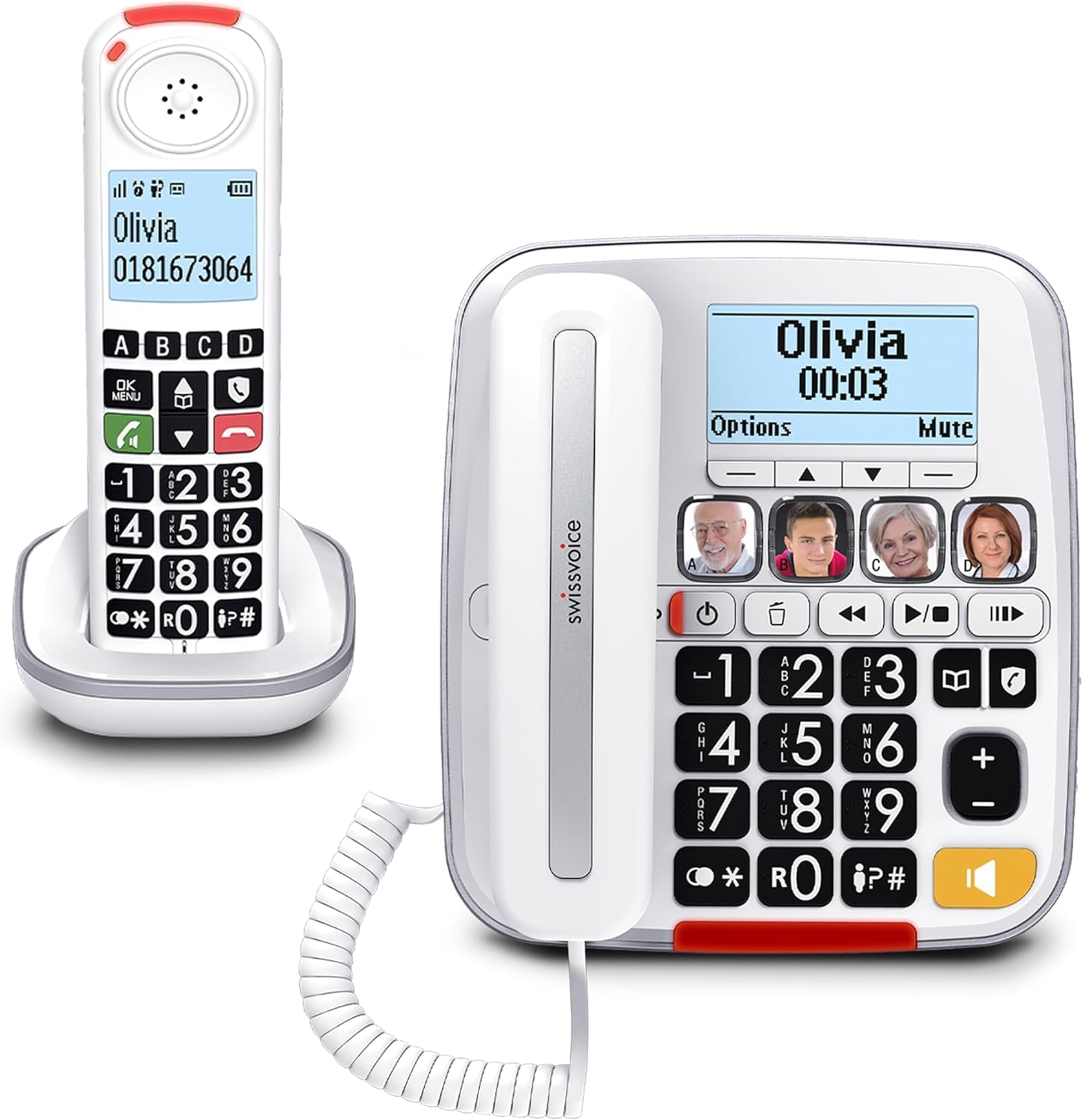
Swissvoice 3355 DECT Big Button Phone
- Large photo-memory buttons — no number dialing needed for saved contacts
- Dedicated SOS button
- Ringer volume up to 90 dB
- Photo buttons require someone to load photos and set up contacts initially
- Fewer advanced call-management features than Panasonic's line
Panasonic KX-TGU432W Amplified Cordless Phone
- Blocks 1,000+ known robocall and scam numbers
- 2.1-inch large display with a flashing Favorites key
- Built-in flashlight on the handset
- 12 dB volume boost
- Volume boost is more modest than the KX-TGM450S's 50 dB
- Menu has more options to learn than the simplest big-button phones
Why a Landline Phone Still Matters
Plenty of seniors keep a home landline specifically because it's simpler and more reliable than a cell phone — no charging habits to maintain, no small on-screen buttons, and it still works during a cell outage. If a cell phone is the better fit instead, our simple smartphones guide and cell phone plans guide cover that path. This guide is specifically about the landline phones built for hearing loss — a different product from a big-button cell phone, and often a better fit for someone who mostly calls from one or two rooms in the house.
Look for Published Decibel Numbers, Not "Extra Loud" Marketing
Generic "senior phone" listings often just say "loud and clear" without a number behind it. The better amplified phones publish an actual decibel boost — for example, a 50 dB incoming-call volume boost and a 90–112 dB visual/audible ringer — which is useful because it lets you compare against a specific hearing loss level rather than guessing from marketing copy. If TV audio, not phone calls, is the bigger daily frustration, our TV listening devices guide covers that separately — the amplification needs are similar in spirit but the devices don't overlap.
Corded vs. Cordless
- Corded: keeps working during a power outage (a real advantage for a landline's core reliability promise), never needs charging, but ties the call to one location.
- Cordless (DECT): handset can move room to room and often includes a base-station speakerphone, but the handset needs regular charging and stops working if the base loses power.
Several current systems now sell a base with one corded-capable unit plus cordless extension handsets, which covers both needs in one purchase.
Our Top Picks
All four below publish specific volume or decibel figures rather than vague marketing language, and each targets a slightly different priority — clarity, ringer loudness, one-touch photo dialing, or extra safety features.
Features Worth Prioritizing
- Photo memory buttons — large buttons pre-programmed with a photo of the person being called, no dialing required.
- Call blocking — several current models block 1,000+ known robocall and scam numbers automatically, which matters for a population that's disproportionately targeted by phone scams.
- Hearing aid compatibility (HAC rating) — confirm this specifically if the user wears hearing aids, since not every amplified phone is optimized to pair with them.
Where These Fall Short
Amplification helps with volume and clarity, but it doesn't fix severe hearing loss the way a properly fitted hearing aid does — if calls are still hard to follow even at maximum volume, that's worth raising with an audiologist rather than buying a louder phone. And a phone alone doesn't help if the real issue is emergency response, not everyday calls — that's what a medical alert system is built for.
When Amplification Alone Isn't Enough
If volume is already turned all the way up and words still get lost, especially consonants, the next step isn't a louder phone — it's a captioned one. Our captioned telephones guide covers how that free FCC-backed captioning service works and which phones display it best.
Match the Amplification to the Level of Hearing Loss
Hearing loss isn't one thing, and the right phone depends on how much and what kind. For mild loss, a modest incoming-volume boost and a louder-than-normal ringer are often enough. For moderate to more advanced loss, look for a phone that advertises a larger incoming-call boost measured in decibels, adjustable tone controls (which let you lift the higher-pitched frequencies where consonants live — the sounds that tend to fade first for older adults), and a slow-playback or replay feature that lets the listener hear a missed sentence again at a gentler pace. If words still blur together even at full volume, the issue is clarity rather than loudness, and no amount of amplification will close that gap — a captioned phone or a properly fitted hearing aid is the better tool. Our captioned telephones guide and OTC hearing aids guide both cover that next step.
Ringers, Flashers, and the Other Half of a Phone Call
Missing the call entirely is as much a problem as struggling once it's answered. A loud, adjustable ringer with a low-pitched tone option carries better through a house than a shrill electronic beep, and a bright visual ringer — a flashing light on the base or handset — is invaluable for anyone whose hearing loss is advanced enough that no ringer volume reliably gets through, or who takes their hearing aids out during the day. If the person also has reduced vision, an oversized flashing indicator matters more than a marginal decibel or two of ring volume.
Vision, Dexterity, and Hearing-Aid Compatibility
Amplified phones are usually bought for hearing, but the same person often has some vision or hand-strength changes too. Large, high-contrast buttons with well-separated keys are easier to dial accurately for arthritic hands and tired eyes, and a backlit display helps in a dim room. If the person wears hearing aids, confirm the phone is hearing-aid compatible (often listed as an HAC rating or T-coil compatibility) so the handset couples cleanly to the aid instead of producing a feedback squeal — this is easy to overlook and a common reason a phone gets quietly abandoned.
How to Choose the Right One for Your Situation
Start with where and how the phone gets used. Someone who spends the day in one or two rooms and values never having to charge anything is well served by a corded amplified phone; someone who moves around the house or wants to carry the handset to the garden is better with a cordless system, ideally one that includes a corded-capable base as a power-outage backup. If scam calls have been a recurring worry, prioritize a model with built-in call blocking. If dialing itself is the struggle — remembering numbers, finding the right contact — a phone with large photo-memory buttons removes that step entirely. And if there's any chance of a fall or medical emergency, remember a phone is not an emergency-response device; pair it with a medical alert system rather than relying on a phone's SOS button alone.
Setup and Getting Started
Most amplified phones work out of the box on a standard landline jack, but a few setup steps make a real difference. Turn the amplification and tone settings up together with the person present, and test a real call rather than guessing — many phones default to standard volume and need the boost switched on deliberately. Program the frequently-called numbers, and if the phone has photo buttons, load clear, well-lit photos of each contact's face. Set the ringer to a volume and pitch the person can actually hear from the rooms they use most, and enable the visual flasher if it has one. Write the most important numbers on a card near the phone as a backup. If a family member is setting it up, do it together once so the senior has tried every button before being left alone with it.
Common Mistakes to Avoid
- Buying on \"loud\" alone. A phone that's loud but muddy can be harder to understand than a quieter one with good tone control. Clarity and adjustable tone matter as much as raw volume.
- Ignoring hearing-aid compatibility. If the person wears hearing aids and the phone isn't HAC-rated, feedback squeal can make it unusable no matter how loud it goes.
- Choosing cordless without a backup. A purely cordless system goes dead in a power outage — the opposite of a landline's main advantage. A corded phone or a hybrid base avoids that.
- Forgetting the ringer and flasher. Amplification helps once the call is answered, but a call that's never heard ringing is a call missed. Set the ringer and visual alert deliberately.
- Assuming louder fixes everything. If speech stays unclear at full volume, the real need is captioning or a hearing aid, not a louder handset.
Caregiver-Friendly Details Worth Checking
If an adult child or helper will be involved, a few details make the phone easier to support from a distance. A built-in answering system with slow playback lets a family member leave a message the senior can replay as many times as needed. Simple, clearly labeled memory buttons mean a caregiver can pre-program the numbers that matter and trust they'll be used. And a phone whose settings don't reset every time the power blips saves repeated re-setup trips. The goal is a phone the senior can use confidently on their own, with a helper needed only for the initial setup — not a device that generates a support call every week.
Frequently Asked Questions
What decibel level of amplification does someone need?
There's no single answer — it depends on the degree of hearing loss, which is best confirmed with a hearing test. As a rough guide, mild loss is often well served by a modest boost, while moderate loss usually calls for a phone advertising a larger incoming-volume increase plus tone adjustment. If you're unsure, choose a model with a wide, adjustable range so it can be turned up as hearing changes over time rather than one with a fixed, modest boost.
Will an amplified phone work with my hearing aids?
Many do, but not all — look for a phone described as hearing-aid compatible (HAC) or T-coil compatible, which is designed to couple cleanly with an aid instead of producing a feedback squeal. If the person wears hearing aids, treat this as a must-have rather than a nice-to-have.
Do amplified phones need special phone service or internet?
No. Unlike captioned phones, a standard amplified phone plugs into an ordinary landline jack and needs no internet connection or account setup. That simplicity is part of the appeal for anyone who wants a phone that just works.
Is a corded or cordless amplified phone better for a senior?
It depends on how they move around. Corded phones never need charging and keep working in a power outage, which suits someone who calls from one spot. Cordless phones let the handset travel room to room but need regular charging and go dead if the base loses power. Many people are best served by a system that includes both a corded-capable base and a cordless extension.
What if the phone is loud enough but words are still hard to follow?
That usually means the problem is speech clarity, not volume — a common pattern once consonant sounds become hard to distinguish. A louder phone won't fix it. The better next step is a captioned telephone, which displays the caller's words as text, or a hearing evaluation to consider hearing aids.
The Bottom Line
Check the actual dB numbers, decide corded vs. cordless based on how the person moves around the house, and prioritize call blocking if scam calls have been a problem — it's a smaller feature on the spec sheet but a real quality-of-life difference day to day. If scam calls are the bigger issue than hearing clarity, our call blocker guide covers dedicated devices that stop far more scam numbers than a phone's built-in blocking list. And if the monthly landline bill itself is the real frustration, our VoIP home phone systems guide covers how to keep the same phone and often the same number while cutting that bill to a few dollars a month. And if the amplification needed goes beyond one phone — for hearing conversations everywhere, not just on a call — our guide to earbuds with a built-in hearing aid feature covers a newer, all-day option.
None of this helps if the phone itself buzzes or cuts out against a hearing aid no matter how loud it's turned up — that's a separate, measurable issue covered in our hearing aid compatible cell phones guide, which explains the FCC's M/T rating system and names which current phones actually score well on it.


