Best Thermometers for Seniors (2026): Ear, Forehead, Oral and Talking Models
Six home thermometers for older adults, from an ear model with a positioning beep to a talking oral thermometer, plus why older adults may not run a typical fever and which readings the NIA and CDC say to watch.
As an Amazon Associate I earn from qualifying purchases. We independently review products; buying through our links never costs you extra.
Best Ear Thermometer
Braun ThermoScan 7 Digital Ear Thermometer
Quick picks
| Product | Best for | Amazon |
|---|---|---|
| Braun ThermoScan 7 Digital Ear Thermometer | Ear Thermometer | Check price on Amazon |
| Braun ThermoScan 4 Digital Ear Thermometer | Simple Ear Thermometer | Check price on Amazon |
| iHealth PT3 No-Touch Forehead Thermometer | No-Touch | Check price on Amazon |
| Exergen TAT-2000C Temporal Artery Thermometer | Forehead Scanner | Check price on Amazon |
| Kinsa QuickCare Smart Digital Thermometer | Tracking Readings | Check price on Amazon |
| Reizen Talking Digital Thermometer | Low Vision | Check price on Amazon |

Our Top Picks
Chosen for seniors based on features, specs, and verified buyer reviews.

Braun ThermoScan 7 Digital Ear Thermometer
- ExactTemp light and beep confirm the probe is positioned correctly
- Pre-warmed tip and infrared reading in seconds
- Color-coded display with age-adjusted fever guidance
- Needs a clean, correctly aimed ear canal to read well
- Disposable lens filters are a running supply
Braun ThermoScan 4 Digital Ear Thermometer
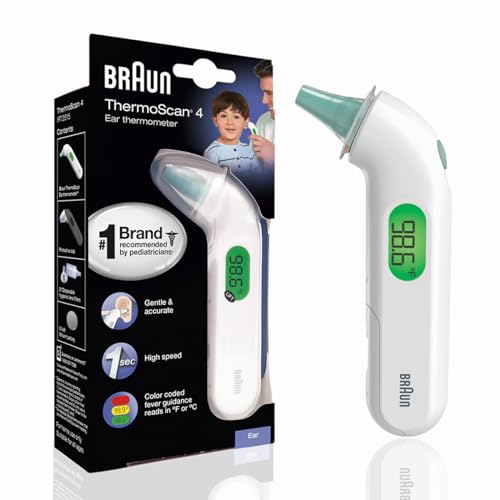
- One-button operation with a backlit LCD
- Green, yellow and red screen with one, two or four beeps
- 21 lens caps and a battery included
- Fewer extras than the ThermoScan 7
- Ear readings depend on probe placement

iHealth PT3 No-Touch Forehead Thermometer
- Reads from about 1.18 inches away without touching the skin
- Extra-large LED display that is readable in the dark
- Vibration alert instead of a beep
- Non-contact readings are more sensitive to sweat, drafts and cold skin
- Takes 2 AAA batteries

Exergen TAT-2000C Temporal Artery Thermometer
- Slide-across-the-forehead scan, no probe in the ear or mouth
- Listing quotes laboratory accuracy of 0.4°F within 98–102°F
- Silent mode and an 8-reading memory
- Needs a deliberate, steady slide from forehead to hairline
- Uses a 9V battery
Kinsa QuickCare Smart Digital Thermometer
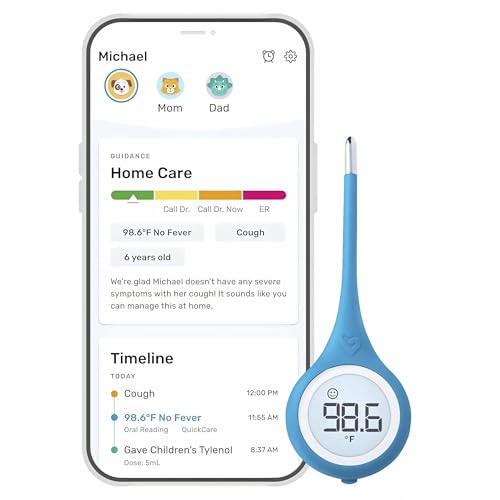
- Oral, underarm or rectal use with a soft flexible tip
- Backlit display and fever indicators; listing says under 8 seconds
- Pairs with the Kinsa app to log readings and share history
- Needs a smartphone to use the app features
- Oral readings need a closed mouth and a short wait after eating or drinking

Reizen Talking Digital Thermometer
- Announces the reading aloud in English and Spanish
- Oral readings in Fahrenheit or Celsius with a fever alarm
- Display range of 89.6–109.4°F; mercury-free, no glass
- Oral thermometer, so no ear or forehead option
- Listing gives few details on battery or memory
Updated November 3, 2026. We did not hands-on test these thermometers. Features come from each product's Amazon listing, checked November 3, 2026. We don't list prices because they change; use the Amazon links for today's price. This guide is general information, not medical advice. As an Amazon Associate we earn from qualifying purchases.
The Short Answer
For most older adults, the best home thermometer is the one you will use the same way every time. A digital ear thermometer such as the Braun ThermoScan 7 is the best all-rounder: quick, no probe in the mouth, and it tells you when it is positioned correctly. Choose an oral digital thermometer with a large display or a spoken readout if you have low vision, a forehead scanner if you want nothing in the ear or mouth, and a no-touch model mainly for quick screening. What matters most after you buy is knowing your own normal. Older adults often run cooler and may not spike a typical fever when they are sick, so a reading that looks unremarkable can still be a change worth acting on.
Why Thermometers Matter More With Age
The "98.6°F means healthy, 101°F means sick" rule of thumb was not built for older bodies. The National Institute on Aging says average normal body temperatures in older adults are slightly lower than in younger adults, so when an older adult is sick, their fever temperatures may also be lower. Citing the CDC, the NIA lists three readings that may signal an infection such as the flu or COVID-19 in an older adult:
- A single reading higher than 100°F (37.8°C)
- Multiple readings above 99°F (37.2°C)
- A rise of more than 2°F (1.1°C) above the person's normal temperature
Those numbers come from the Infectious Diseases Society of America's guideline for older residents of long-term care facilities, which defines fever the same way for oral and rectal readings (a single oral temperature above 100°F, repeated oral readings above 99°F or rectal readings above 99.5°F, or a rise of more than 2°F over baseline). The guideline notes that as people age and become frail, basal body temperature falls, so classic fever definitions are met less often. MedlinePlus puts it plainly: when an older person has an infection, their body may not be able to produce a higher temperature, so check other signs too.
That last point is why a thermometer is a tool, not a verdict. The IDSA guideline lists new or increasing confusion, falling, worsening mobility and reduced eating as signs that infection should be suspected even without a fever, and the NHLBI says older adults with pneumonia may have a lower-than-normal temperature instead of a fever and may feel weak or suddenly confused. If someone you care for is acting differently, tell their clinician, whatever the thermometer says.
The cold side matters too. The NIA defines hypothermia as a core body temperature below 95°F, calls it a medical emergency, and warns that older adults can develop it even in mildly cool homes of 60 to 65°F. That is one more reason to check the low end of a thermometer's display range, as we explain below.
What We Looked For
- A display you can read without squinting. Large digits, a backlight or a spoken readout beat a tiny gray LCD at 3 a.m.
- Few steps. One button, clear beeps, and a clear signal that the reading is done. Fiddly positioning rules cause bad readings.
- A method you can repeat. We covered ear, oral, forehead scan and no-touch designs, because the best site is the one the person will accept and the helper can aim consistently.
- Honest limits. Every type has weak spots. Mayo Clinic notes that earwax and ear infections can make ear readings less accurate, and that forehead thermometers can be less accurate in direct sunlight, in cold air or on a sweaty forehead. We repeat those cautions where they apply.
- Listing facts only. We quote what each manufacturer says about its own product and attribute it. We do not claim to have verified accuracy.
Quick Comparison
| Thermometer | Type | Standout feature (listing) | Best for |
|---|---|---|---|
| Braun ThermoScan 7 | Ear (infrared) | ExactTemp positioning light and beep; age-adjusted guidance | All-round home use |
| Braun ThermoScan 4 | Ear (infrared) | One button; green, yellow, red screen with one, two or four beeps | Keeping it simple |
| iHealth PT3 | No-touch forehead | Reads from about 1.18 in.; large LED; vibration alert | Quick checks, shared homes |
| Exergen TAT-2000C | Temporal artery (forehead slide) | Quoted lab accuracy of 0.4°F in 98–102°F; silent mode | Nothing in the ear or mouth |
| Kinsa QuickCare | Oral, underarm, rectal | App logs readings; flexible tip | Tracking trends, caregivers |
| Reizen Talking Thermometer | Oral | Spoken readout; 89.6–109.4°F display range | Low vision |
Our Picks, Explained
These aren't ranked. Match the thermometer to the person who will use it and the person who will help.
Braun ThermoScan 7: the all-round ear thermometer
The ThermoScan 7 is the one to start with. Braun's listing describes a pre-warmed tip and infrared reading that takes a temperature in seconds, plus an ExactTemp system that uses a light and a beep to confirm the probe is positioned properly in the ear. That feedback is the useful part for older adults and for family members taking a reading for them, because ear thermometers are only as good as their aim. The listing also describes Age Precision technology for age-adjusted fever guidance and a color-coded display, and says disposable lens filters make sharing hygienic. Keep a box of filters in the same drawer. Mayo Clinic's cautions apply: earwax, an ear infection or an unusually shaped canal can throw off an ear reading, and you should wait about 15 minutes after coming in from the cold or heat. If the person wears hearing aids, check the manual for placement.
Check the Braun ThermoScan 7 on AmazonCheck price on AmazonBraun ThermoScan 7 Digital Ear Thermometer
Braun ThermoScan 4: the simple, color-coded one
If the ThermoScan 7 has more features than you want, the ThermoScan 4 trims them. Braun's listing describes one-button operation, a backlit LCD that turns green for a normal result with one beep, yellow for a fever with two beeps and red for a high fever with four beeps, and a one-second reading. It ships with 21 lens caps and a battery. The color and sound cues help someone who struggles to read small numbers. Remember that the thresholds on the screen are general ones. For an older adult, the NIA and IDSA numbers above are lower than a typical "fever" cutoff, so write the actual number down and compare it with the person's usual readings rather than relying on the color alone.
iHealth PT3: the no-touch forehead thermometer
The PT3 reads without touching the skin. iHealth's listing says it measures from within about 1.18 inches of the center of the forehead, reads in one second, shows the result on an extra-large LED display that is visible in total darkness, and gives a gentle vibration to the holding hand instead of a beep. It takes two AAA batteries and carries a 12-month warranty. That makes it convenient for checking someone who is asleep and for households where several people share one device. The trade-off is accuracy. The FDA says how and where a non-contact thermometer is used can affect the measurement, and Health Canada says non-contact models are more susceptible to inaccurate readings than oral, rectal or well-used ear thermometers, with sweat, makeup, hats, scarves, direct sun, heaters and recent cold or hot weather all playing a part. Use it indoors, in a draft-free room, with a dry bare forehead, and confirm any surprising result with an oral or ear reading.
Check the iHealth PT3 on AmazonCheck price on AmazoniHealth PT3 No-Touch Forehead Thermometer
Exergen TAT-2000C: the forehead scanner with a track record
Exergen's temporal artery design is different from a point-and-click no-touch model: you place the probe at the center of the forehead, hold the button, slide straight to the hairline, release and read. Exergen's listing quotes laboratory accuracy of 0.4°F within the normal fever range of 98 to 102°F, says it was founded in 1980 and introduced temporal artery scanning, and adds a silent mode, an 8-reading memory and a 9V battery. Laboratory accuracy is not the same as accuracy in your kitchen, and we did not test it, but the slide technique is more forgiving to repeat than a hovering sensor. It is a good choice if the person dislikes anything in the ear or mouth. Keep the sensor clean, take the reading in a comfortable room, and wipe off sweat first.
Kinsa QuickCare: the oral thermometer that keeps a log
The QuickCare is a conventional digital thermometer with a smartphone layer. Kinsa's listing says it is FDA-cleared, takes oral, underarm or rectal readings with a soft, flexible tip, delivers a reading in under 8 seconds, and has a backlit display with fever indicators. Paired with the Kinsa app, it logs temperatures and symptoms for each family member and lets you share the history. For caregivers, a dated list of readings is more useful at a doctor's visit than "she felt warm Tuesday." Oral readings need a closed mouth and a short wait after hot or cold drinks, so this is best for someone who can follow the steps. You need a smartphone to use the app features, though the thermometer works on its own.
Check the Kinsa QuickCare on AmazonCheck price on AmazonKinsa QuickCare Smart Digital Thermometer
Reizen Talking Digital Thermometer: for low vision
For someone who cannot read a screen, a spoken result is a real independence tool. The listing for the Reizen says the reading is announced in a clear voice in English and Spanish, that oral readings come in Fahrenheit or Celsius, and that a fever alarm sounds when the thermometer reaches its peak reading. The listed display range is 89.6 to 109.4°F, and it has a flexible tip and is mercury-free with no glass. The range is worth noticing. Standard thermometers may not register very low temperatures, and the NIA treats a body temperature below 95°F as a medical emergency. A device that shows readings down to 89.6°F is not a diagnostic tool for hypothermia, but if any thermometer shows a very low or unreadable result, or if the person shows warning signs such as slurred speech, confusion, shivering or sleepiness, call 911 rather than trying again and waiting. The listing gives few details on battery or memory, so check the product page before you buy.
Pair it with a talking clock and you have a bedside routine that needs no reading glasses.
Check price on AmazonReizen Talking Digital Thermometer
Which Type Fits Which Person
- Independent, comfortable with simple devices: an ear thermometer like the ThermoScan 7 or 4, or the Kinsa QuickCare if you want a history.
- Low vision: the talking Reizen, or an ear model with color and beep cues and a helper reading the number back.
- Dementia or someone who resists oral or ear readings: a forehead scanner such as the Exergen is usually the least intrusive. Take the reading when the person is calm and still.
- Shared homes and caregivers: a no-touch model for quick checks, with an ear or oral reading as the confirmation.
- Tremor or arthritis: favor a device with a big grip and a single large button, and avoid designs that need a precise, steady slide.
How to Get a Reading You Can Trust
- Read the manual once. The FDA stresses following the manufacturer's instructions, since correct distance and placement differ by model.
- Take a baseline while healthy. Measure at the same time of day, with the same thermometer and the same method, for a few days and write the numbers down. Every threshold for older adults relies on knowing "normal for this person."
- Don't switch methods mid-illness. Ear, forehead, oral and underarm readings can differ from one another. If you change devices, note it.
- Let the person and the thermometer settle. Wait about 15 minutes after being outdoors in the cold or heat before an ear reading, and give non-contact thermometers 10 to 30 minutes in the room, as the FDA's guidance describes.
- Prep the spot. Dry the forehead, move hair and hats aside, and keep out of drafts, direct sun and heater range. Clean the ear probe or lens as the manual directs.
- Record the number, the method and the time, along with changes such as confusion, a fall, poor appetite or new cough. A small notebook, or the Kinsa app, works.
- Call a clinician about patterns. A single reading above 100°F, repeated readings above 99°F, or a rise of more than 2°F over baseline is worth a call, per the NIA and CDC guidance above. Sudden confusion, trouble breathing or signs of hypothermia mean calling 911.
Other Gear That Pairs With a Thermometer
A thermometer is one number. Patterns come from a few. If the person has a heart or lung condition, a pulse oximeter and a blood pressure monitor belong in the same drawer, and a weekly pill organizer keeps medicines straight when you are tracking symptoms. In winter, check the room too: a smart thermostat helps keep the home at the 68 to 70°F the NIA recommends, and our guide to space heaters for seniors covers the safer ways to add warmth.
Common Mistakes to Avoid
- Using only the "fever" label on the screen. The preset thresholds on consumer thermometers are not built around older adults. Use the actual number and the person's baseline.
- Trusting a no-touch reading right after coming inside. Cold skin gives a low reading. Wait, then repeat.
- Taking an ear reading with a plugged or infected ear. Mayo Clinic says earwax and ear infections can make ear readings less accurate. Use another site.
- Skipping the lens filter or cleaning step. Dirty probes spread germs and can skew results.
- Assuming "no fever" means "no problem." In older adults, infection may show up as confusion, weakness, a fall or not eating.
- Ignoring a very low reading. If the thermometer can't read it or the temperature appears to be below 95°F, treat it as a possible emergency and call 911.
Frequently Asked Questions
What is the best thermometer for seniors?
For most people, a digital ear thermometer like the Braun ThermoScan 7 is the best all-rounder, because it is quick and signals proper placement. For low vision, a talking oral model such as the Reizen is easier. For someone who resists anything in the ear or mouth, a forehead scanner like the Exergen TAT-2000C is the least intrusive option.
What temperature is a fever in an older adult?
The NIA, citing the CDC, lists a single reading above 100°F (37.8°C), multiple readings above 99°F (37.2°C), or a rise of more than 2°F (1.1°C) above the person's normal temperature as possible signs of infection. These are lower than the usual 101°F cutoff because older adults often run cooler. Talk to a health care provider if you're concerned.
Can an older person be sick without a fever?
Yes. MedlinePlus says that when an older person has an infection, their body may not be able to produce a higher temperature, and the NHLBI says older adults with pneumonia may have a lower-than-normal temperature instead of a fever. New confusion, weakness, falls or reduced eating can be the first sign, so report those changes even when the thermometer looks normal.
Are forehead and no-touch thermometers accurate for seniors?
They can be useful for screening, but the FDA and Health Canada both caution that they are more sensitive to how and where they are used. Sweat, makeup, hats, drafts, direct sun, heaters and recent cold or hot weather can all change the reading. If a no-touch reading is surprising, repeat it indoors on a dry forehead and confirm it with an oral or ear reading.
Are ear thermometers safe and accurate for older adults?
Mayo Clinic says ear thermometers are quick and generally comfortable for adults when positioned properly, but that earwax, ear infections and the shape of the ear canal can reduce accuracy. Wait about 15 minutes after coming in from the cold or heat, and clean the probe after each use.
What should I do if the thermometer shows a very low temperature?
A body temperature below 95°F is a medical emergency, according to the NIA. If a reading is that low or the thermometer cannot register one, and the person is shivering, sleepy, confused or speaking slowly, call 911, move them to a warmer place and wrap them in dry blankets. Don't use a heating pad or rub their arms or legs.
Do I need a smart thermometer?
No. A plain digital thermometer works. A smart model like the Kinsa QuickCare is helpful mainly if a caregiver wants a dated log of readings and symptoms to share with a clinician. Whichever you choose, writing down the number, the method and the time matters more than the app.
The Bottom Line
Buy the thermometer that the person can use easily and the helper can aim consistently, then take a baseline before cold and flu season ramps up. The Braun ThermoScan 7 suits most homes, the Reizen suits low vision, the Exergen suits people who resist anything in the ear or mouth, and the Kinsa QuickCare suits families who want a log. Whatever you use, remember that older adults may not run a classic fever, so pair the number with how the person is acting. Before you buy, check the current price of the Braun ThermoScan 7 on Amazon and compare it with the other picks above.
Sources
- National Institute on Aging, Flu and Older Adults (recognizing a fever in older adults)
- Infectious Diseases Society of America, Clinical Practice Guideline for the Evaluation of Fever and Infection in Older Adult Residents of Long-Term Care Facilities: 2008 Update, Clinical Infectious Diseases 48(2)
- MedlinePlus, Aging changes in vital signs
- NHLBI, Pneumonia: Symptoms
- National Institute on Aging, Cold Weather Safety for Older Adults
- U.S. Food and Drug Administration, Non-contact Infrared Thermometers
- Health Canada, Non-contact infrared thermometers (NCIT)
- Mayo Clinic, Thermometers: Understand the options
- Amazon product listings for each pick, checked November 3, 2026
- Photo: Vlada Karpovich via Pexels


