Best TV Antennas for Seniors (2026): Free Local Channels Without Cable, Set Up Simply
Channel Master FLATenna, Amazon Basics, Mohu Leaf, ClearStream Eclipse 2 and ClearStream 2MAX compared for setup, bands and signal strength, using the FCC's antenna guidance and reception maps. Updated October 20, 2026. No invented prices or test results.
As an Amazon Associate I earn from qualifying purchases. We independently review products; buying through our links never costs you extra.
Simplest Setup
Channel Master FLATenna Indoor HDTV Antenna
Quick picks
| Product | Best for | Amazon |
|---|---|---|
| Channel Master FLATenna Indoor HDTV Antenna | Simplest Setup | Check price on Amazon |
| Amazon Basics Ultra Thin Indoor TV Antenna | Budget Pick | Check price on Amazon |
| Mohu Leaf Paper-Thin Indoor HDTV Antenna | a VHF Station | Check price on Amazon |
| Antennas Direct ClearStream Eclipse 2 Amplified Indoor TV Antenna | Switchable Amplifier | Check price on Amazon |
| Antennas Direct ClearStream 2MAX Indoor/Outdoor TV Antenna | Attic or Outdoor Option | Check price on Amazon |

Our Top Picks
Chosen for seniors based on features, specs, and verified buyer reviews.
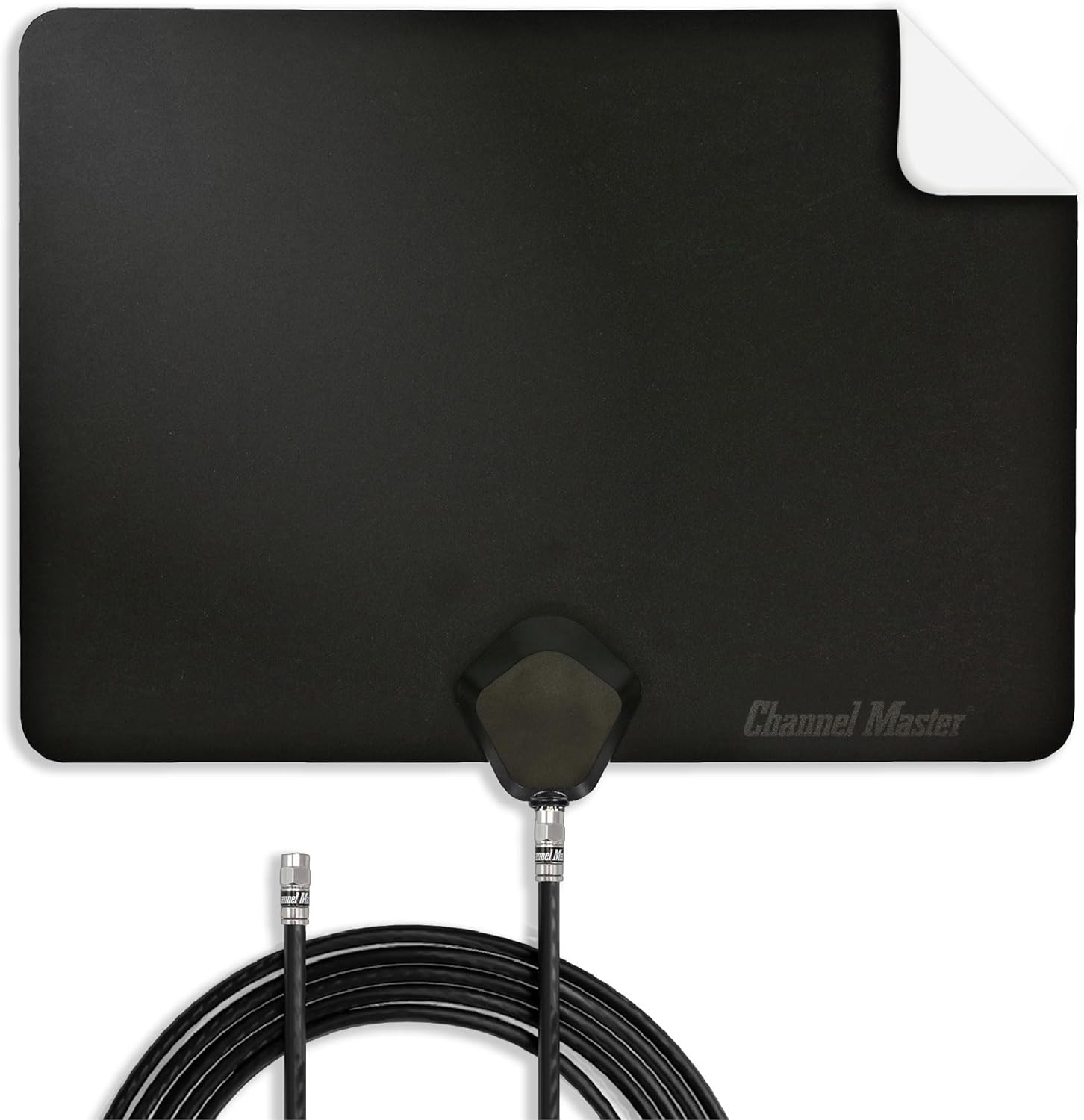
Channel Master FLATenna Indoor HDTV Antenna
- 35-mile range (listing)
- 12 ft RG6 coax included
- No power or amplifier to manage
- Reversible; wall, window or tabletop mounting
- Strong-signal areas only
- NextGen TV still needs a compatible TV

Amazon Basics Ultra Thin Indoor TV Antenna
- 35-mile range (listing)
- 10 ft coax included
- Multi-directional: no pointing needed (listing)
- No power needed
- Shorter cable than some picks
- Strong-signal areas only

Mohu Leaf Paper-Thin Indoor HDTV Antenna
- UHF and Hi-VHF elements (listing)
- 10 ft detachable coax
- Hangs on wall or window with included tabs and pins
- Made in USA (listing)
- Range claim depends heavily on location
- Non-amplified

Antennas Direct ClearStream Eclipse 2 Amplified Indoor TV Antenna
- 18 dB USB amplifier with on/off switch (listing)
- 12 ft coax included
- 16.5 x 8.6 in paper-thin panel
- Amplifier powered from the TV's USB port
- UHF element: check for VHF stations first
- Extra USB connection to explain

Antennas Direct ClearStream 2MAX Indoor/Outdoor TV Antenna
- UHF and Hi-VHF elements (listing)
- Indoor base, attic, or outdoor on included 20 in mast
- 60-degree beam front and back (listing)
- Virtually no assembly (listing)
- Large: 17.4 x 31.3 x 4 in
- Attic or roof install needs a helper or installer
Updated October 20, 2026. Short answer: before buying any antenna, put your address into the FCC's free DTV Reception Maps to see which local stations reach your home and how strong they are. If they show strong signals, a flat, non-amplified indoor antenna is the easiest thing for an older adult to live with: one cable, nothing to plug in, nothing to adjust once it works. The Channel Master FLATenna and the Amazon Basics Ultra Thin antenna both fit that description, and the paper-thin Mohu Leaf is a long-running alternative. For moderate signals, the ClearStream Eclipse 2 adds an amplifier you can switch on and off. If indoor antennas can't reach your stations, the ClearStream 2MAX can go in an attic or outside. This guide uses the FCC's consumer guidance and details from live Amazon listings checked October 20, 2026. We didn't invent prices, ratings or test results.
Why an antenna is worth a look for seniors
Many older adults pay for cable or satellite mostly to watch the local news, network shows, weather and sports from local stations. Those same stations broadcast for free over the air. With an antenna and almost any modern TV, there's no monthly bill for them, no contract and no internet connection needed. Amazon's listings for every antenna below say the same thing in plain terms: local networks such as ABC, CBS, NBC, PBS and Fox where they broadcast in your area, and no cable channels. That last part matters. An antenna won't bring in cable-only networks, so if a parent's favorite channel is a cable network, pair the antenna with one of the streaming devices we recommend for seniors rather than expecting it to replace everything.
There's also a practical safety angle. Local broadcast TV doesn't depend on a home internet connection, so the local weather and news can still come through when the Wi-Fi is down, as long as the TV itself has power. For full power outages, a battery or hand-crank emergency weather radio is still the better backup.
Check your address first (this decides everything)
Reception depends on where you live far more than on which antenna you buy. The FCC's DTV Reception Maps let you type in an address and see the stations you can expect, how strong each signal is likely to be, and the direction of the towers. The FCC's antenna guide then gives a simple rule of thumb:
- Strong signals: simple indoor antennas may be enough.
- Moderate signals: a high-quality indoor antenna or an outdoor antenna may be appropriate.
- Weak signals: an outdoor antenna is appropriate.
The FCC also says outdoor antennas generally get better reception than indoor ones and are strongly recommended for the most reliable reception. Indoor antennas are popular because they're easy, not because they're always enough.
Look at one more column on the map: whether each station broadcasts on a VHF channel (2 to 13) or a UHF channel (14 to 36). The FCC warns that many antennas sold as "HDTV antennas" work best on UHF and less well on VHF. If a station you care about is on VHF, choose an antenna whose listing mentions VHF reception (the Mohu Leaf and ClearStream 2MAX listings name UHF and Hi-VHF elements).
How we chose
- Setup a non-technical person can manage: one coaxial cable to the TV, and either no power at all or USB power from the TV itself.
- Cable length on the listing (10 to 12 feet for the indoor picks), because the best spot for an antenna is often a window, not behind the TV.
- Range and band information stated on the listing, read with the caution that every listing itself gives: distance, terrain, trees and building materials change real-world results.
- A path for every signal level: non-amplified flat antennas, a switchable amplified model, and an attic/outdoor antenna.
- Features we could verify on live Amazon listings on October 20, 2026. We didn't test these antennas in a lab, and range figures are the manufacturers' claims.
Comparison table
| Pick | Type | Listed range | Bands (listing) | Cable / power (listing) | Best for |
|---|---|---|---|---|---|
| Channel Master FLATenna (B074TWSQFM) | Flat indoor, non-amplified | 35 miles | Local HD and digital signals; ATSC 3.0 support stated | 12 ft RG6 coax; no power | Simplest setup with strong signals |
| Amazon Basics Ultra Thin (B00X4RA74A) | Flat indoor, non-amplified | 35 miles | Multi-directional, "no pointing needed" | 10 ft coax; no power | Budget pick with strong signals |
| Mohu Leaf paper-thin antenna (B004QK7HI8) | Flat indoor, non-amplified | 40 miles (listing bullet) | UHF and Hi-VHF elements | 10 ft detachable coax; no power | Homes with a VHF station to catch |
| ClearStream Eclipse 2 (B081HGCT5L) | Flat indoor, amplified | Not stated on listing | UHF element | 12 ft coax; 18 dB USB amplifier with on/off switch | Moderate signals, UHF stations |
| ClearStream 2MAX (B074CQ5LCJ) | Indoor/attic/outdoor | Not stated on listing | UHF 470–608 MHz and Hi-VHF 174–216 MHz | Includes 20 in mast and indoor base; no amplifier | Weaker signals; attic install feeding the TV |
The five picks
1. Channel Master FLATenna: the simplest indoor antenna for strong signals
Channel Master's listing describes a 35-mile range, an ultra-thin reversible black-and-white panel that mounts on a wall, a window or a tabletop, and a 12-foot RG6 coaxial cable. It's not amplified, so there's no power cord or USB plug to explain. The listing also says it supports ATSC 3.0 (NextGen TV) and 4K broadcasts. That's worth understanding correctly: NextGen TV depends on the TV or tuner, not the antenna, so an older TV won't gain NextGen features just because the antenna supports them. Choose it when the FCC map shows strong signals and you want the setup with the fewest parts.
Check price on AmazonChannel Master FLATenna Indoor HDTV Antenna
2. Amazon Basics Ultra Thin Indoor TV Antenna: the budget pick
The Amazon Basics listing gives a 35-mile range, a reversible black or white panel that can be painted, a 10-foot coaxial cable and a multi-directional design with "no pointing needed." It doesn't need power. The listing is upfront that reception varies with what's broadcast locally, distance from the towers and obstructions. For an apartment or house close to the towers, it does the same basic job as pricier flat antennas. Choose it when the map shows strong signals and the TV is near a window.
Check price on AmazonAmazon Basics Ultra Thin Indoor TV Antenna
3. Mohu Leaf paper-thin indoor antenna: when a VHF station matters
Mohu's listing for this paper-thin antenna names UHF and Hi-VHF multi-directional elements, a 40-mile reception claim, a 10-foot detachable coaxial cable, hook-and-loop tabs and push pins for hanging, and it states the antenna is made in the USA. The listing recommends hanging it on a wall or in a window for the best performance. Because the FCC specifically warns that many HDTV antennas are weaker on VHF, this is the flat antenna to try first if your reception map shows a station you want on a VHF channel (7 to 13 fall in the Hi-VHF range). Choose it for strong-to-moderate signals with a VHF station in the mix.
Check price on AmazonMohu Leaf Paper-Thin Indoor HDTV Antenna
4. ClearStream Eclipse 2: amplified, with an off switch
Antennas Direct's listing describes a patented double-loop paper-thin design measuring 16.5 by 8.6 inches, a 12-foot coaxial cable, and the Jolt Switch 18 dB in-line amplifier powered from a USB port, with a switch so you can turn amplification on or off as needed. That switch is the reason it's on this list. The FCC notes that amplifiers can overload the tuner when you're close to a tower, so being able to compare "on" and "off" with a quick rescan is useful. The listing describes a UHF element, so check your reception map for VHF stations before relying on it. Choose it for moderate signals where flat non-amplified antennas came up short.
5. ClearStream 2MAX: attic or outdoor when indoor isn't enough
The 2MAX listing describes dedicated UHF and Hi-VHF elements (UHF 470 to 608 MHz, Hi-VHF 174 to 216 MHz) with a 60-degree beam angle front and back, dimensions of 17.4 by 31.3 by 4 inches, and installation options indoors on the included base, in an attic, or outdoors on the included 20-inch mast with a pivoting base. It's the most capable antenna here and the least suited to a do-it-yourself senior: attic and roof work is a job for a family member or an installer, not someone who should avoid ladders. Choose it when the reception map shows moderate or weak signals and an attic or outdoor spot is available.
Setting it up so a parent can actually use it
- Find the window that faces the towers. The FCC reception map shows the direction. Higher is usually better, and the FCC notes that moving an antenna even a few inches can change reception.
- Connect the coax cable to the TV's antenna input (often labeled ANT IN, Cable/Antenna or RF).
- Switch the TV input to Antenna, Air or Live TV, then run a channel scan from the settings menu. Write the steps on a card and keep it with the remote.
- Use the TV's signal strength meter if it has one, move the antenna slowly, and rescan after each move, as the FCC suggests.
- Rescan every few months, or whenever a channel disappears. Stations occasionally change channels, and the FCC recommends periodic rescans.
- Make the input easy to find. The most common support call is "the TV says no signal," which usually means the TV is on an HDMI input. A large-button remote with a clearly marked input button helps, and a TV listening device helps if volume and dialogue are the real complaint.
Who should skip an indoor antenna
If the reception map shows weak signals, the FCC's guidance points to an outdoor antenna, and a flat indoor model is likely to disappoint. If a parent mainly watches cable-only channels, an antenna won't help much on its own. If the TV is very old, check that it has a digital (ATSC) tuner. Most sets sold in the US since the 2009 digital transition do. And if the household already has a smart TV with a live TV guide, look for the antenna option in that guide: many smart TVs mix antenna channels into the same on-screen guide as streaming apps, which can be easier than switching inputs.
FAQ
What is the best TV antenna for seniors?
For most homes within about 30 miles of the broadcast towers, a flat, non-amplified indoor antenna is the simplest choice because there is no power cord, no amplifier and nothing to adjust once it works. The Channel Master FLATenna (35-mile range on the listing, 12 ft cable, multi-directional) and the Amazon Basics Ultra Thin antenna (35-mile range, 10 ft cable) both fit that description. If the free FCC reception map shows weaker signals, try an amplified model like the ClearStream Eclipse 2, whose amplifier can be switched off. If indoor antennas don't pull in your stations, an attic or outdoor antenna such as the ClearStream 2MAX is the next step.
Will an indoor antenna work at my house?
Check before you buy. Enter your address in the FCC's DTV Reception Maps, which list the stations you can expect, their signal strength and whether each broadcasts on a VHF or UHF channel. Strong signals usually work with a simple indoor antenna. Moderate signals may need a better indoor antenna or an outdoor one, and weak signals generally need an outdoor antenna, according to the FCC's antenna guide.
Do I need an amplified antenna?
Only if your signals are weak or the cable run is long. The FCC notes that if you live near a station's broadcast tower, an amplifier can actually make reception worse by overloading the tuner. Start without an amplifier, or with one you can switch off, and add amplification only if a scan finds fewer channels than the reception map says you should get.
How do I switch my TV to the antenna channels?
Press the Input or Source button on the remote and choose the input labeled Antenna, Air, Live TV or TV (not HDMI). Then run a channel scan from the TV's settings menu, which may be called Auto Program, Channel Scan or Auto Tune. The FCC recommends rescanning periodically, because stations sometimes change channels. A family member can put a small label on the remote's Input button to make switching easier.
Is there a monthly fee for antenna TV?
No. Over-the-air broadcasts from local stations are free once you have an antenna and a TV with a digital tuner (almost every modern TV has one). There is no subscription and no internet connection required. Which networks you get depends on the stations broadcasting where you live.
Why don't you list prices?
Amazon prices change often. We checked listing details on October 20, 2026 and left prices off so the page doesn't go stale. Use the buttons for today's price.
Sources
- Federal Communications Commission, "Antennas and Digital Television" (signal-strength guidance, VHF/UHF, amplifier overload, rescanning): https://www.fcc.gov/consumers/guides/antennas-and-digital-television
- Federal Communications Commission, DTV Reception Maps: https://www.fcc.gov/media/engineering/dtvmaps
- Amazon product listings for the Channel Master FLATenna (B074TWSQFM), Amazon Basics Ultra Thin Indoor TV Antenna (B00X4RA74A), Mohu Leaf paper-thin antenna (B004QK7HI8), Antennas Direct ClearStream Eclipse 2 (B081HGCT5L) and ClearStream 2MAX (B074CQ5LCJ), details checked October 20, 2026 (linked from the buttons below)

